
Can we help you?
Contact us

Can we help you?
Contact us
Thank you for contacting us
Your form has been submitted successfully Our team will contact you again as soon as possible.
Whooppss...!! An error has occurred
Try sending later or write an email directly to areaempresas@ua.es

INFO
SHEET
DOWNLOAD
EXECUTIVE
ABSTRACT
CONTACT DETAILS: Research Results Transfer Office-OTRI
University of Alicante
Tel.: +34 96 590 99 59
Email: areaempresas@ua.es
http://innoua.ua.es
The «Química Agrícola» (Agricultural Chemistry) research group at the University of Alicante has developed a production process —simple, rapid and free of chemical additives— and the sustainable growing substrate obtained with it, made from the remains of the marine plant Posidonia oceanica that accumulate on Mediterranean beaches and are removed to municipal landfills. The substrate is a natural-origin alternative to peat and, besides serving as a growing medium for horticultural species, it improves the organoleptic properties —flavour and aroma— of their fruits.
The conditioning procedure is purely physical (sorting, washing with water, drying and grinding) and is completed in a maximum of 5 days, keeping the plant's beneficial compounds intact. The result is an active growing medium that retains water well, releases nutrients progressively and stimulates the crop's natural production of the substances responsible for the fruit's flavour and aroma, while also allowing a proportion of Posidonia oceanica far higher than earlier techniques considered viable.
The technology, protected by a patent application, has been validated in a relevant environment (experimental greenhouse) and is currently part of a proof-of-concept project to raise its technology readiness level. It is aimed at sectors such as horticultural production, the growing-media and substrate industry, and organic farming. Companies interested in its validation and commercial exploitation are sought.
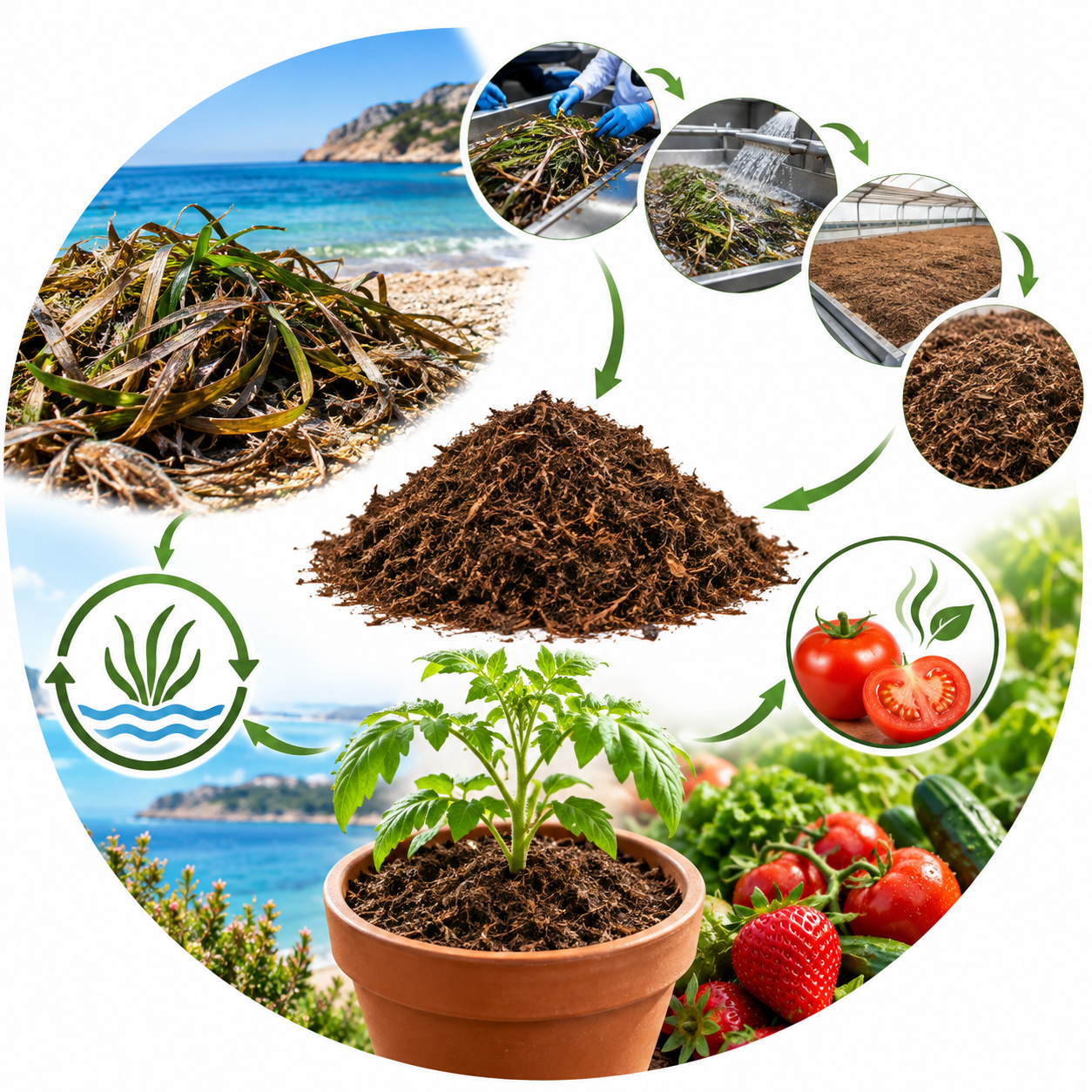
Today's agricultural sector faces a twofold challenge: the progressive loss of flavour and quality properties in widely consumed crops such as tomato, and the accelerated degradation of fertile soils associated with climate change.
To safeguard production, growers increasingly turn to greenhouse cultivation on growing substrates. However, the sector's reference material, peat, poses serious sustainability problems: its extraction destroys ecosystems that act as carbon sinks and releases large amounts of greenhouse gases. In agronomic terms, this is compounded by its high variability, which requires constant corrections and considerably increases production costs.
As an alternative within the circular economy, there is a highly abundant marine waste: the remains of the marine plant Posidonia oceanica, which accumulate massively on Mediterranean beaches. Their removal entails a high cost for municipalities and, at present, these remains end up inefficiently deposited in landfills. Although it is a material rich in nutrients and in molecules beneficial to plant growth, earlier technological developments to turn it into a growing substrate show significant shortcomings. These shortcomings are of three kinds:
• Existing composting methods require excessively long production times (several months) and use complex conditioning with chemical reagents that alter the plant's natural composition.
• Other approaches require mixing the waste with soil, mineral particles or pesticides, whereby it loses its status as a standalone growing substrate.
• Previous scientific research shows that, when the proportion of this waste in the substrate exceeds 30 %, crops suffer harmful effects —yield losses and disturbances in plant nutrition— owing, among other factors, to high salinity.
As a result, to date none of these precedents has managed to improve the organoleptic qualities (flavour and aroma) of the fruits or to demonstrate a viable industrial application.
In the face of these limitations, a technology is needed that can valorise this waste directly, rapidly and without harmful chemical additives, preserving the structure and the beneficial compounds of the marine plant. Only a development of this kind would make it possible to offer a sustainable alternative to peat —while also reducing the municipal cost of managing the waste— and, at the same time, to provide an efficient growing medium that stimulates plant development and improves their quality properties. The technology presented below responds to this need.
The «Química Agrícola» research group at the University of Alicante has developed a production process —simple, rapid and free of harmful chemical additives— and the sustainable growing substrate obtained with it. The technology is based on valorising dead beach-cast Posidonia oceanica (which naturally includes leaves, fibres and rhizomes), a waste that is abundant along Mediterranean coasts. The material undergoes controlled physical conditioning and is combined with an inert substance that acts as a neutral support and improves the texture, aeration and water retention of the growing medium.
Compared with traditional composting methods, which require chemical treatments and months of maturation, the process is purely physical and is completed in a maximum of 5 days, in five steps (see Figure 1):
1. Initial cleaning: plastics and unwanted organic debris are manually removed from the beach-cast material.
2. Natural washing: only ordinary water is used to remove adhering sand and reduce excess surface salts, with no chemical reagents.
3. Drying: the cleaned material is air-dried naturally.
4. Physical conditioning: the dried parts are ground and sieved to homogenise their size.
5. Final formulation: the conditioned material is mixed with the inert substance to obtain the growing substrate ready for distribution.
Unlike a conventional organic substrate, which functions only as physical support, this medium interacts actively with the crop: it regulates moisture and stabilises the pH of the root zone, progressively releases assimilable mineral nutrients and, because Posidonia oceanica retains its natural bioactive compounds (antioxidants and protective molecules), it stimulates the plant's synthesis of the sugars and volatile compounds responsible for the fruit's flavour and aroma.
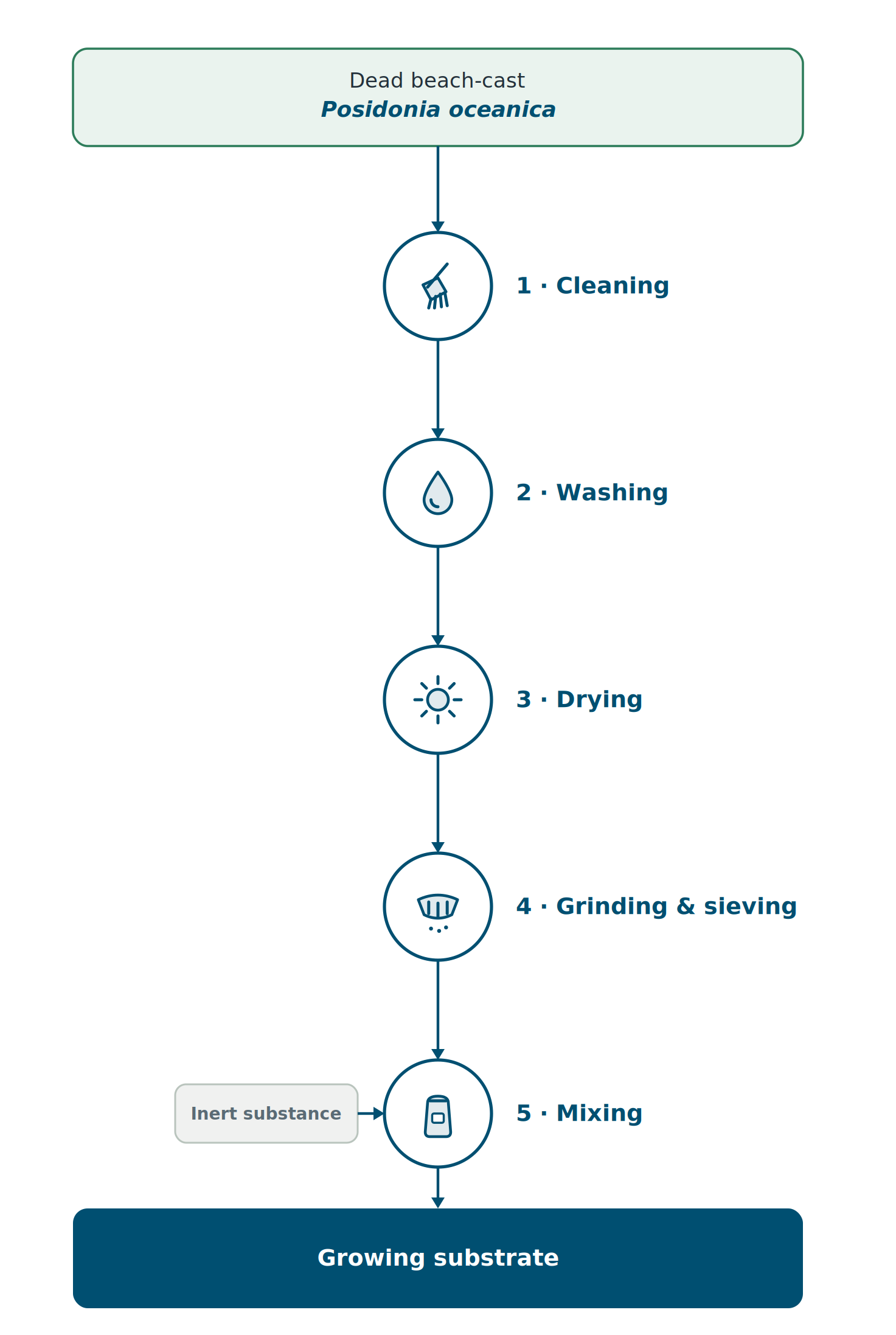
Figure 1. Growing-substrate production process
ADVANTAGES OF THE TECHNOLOGY
The main competitive advantages of the developed growing substrate are as follows:
• Fast manufacturing, without composting: the substrate is ready in a maximum of 5 days, compared with the 9–12 months required by conventional composting. This speed simplifies production and reduces storage requirements.
• Simple, chemical-free process: it is easy to prepare and requires no specialised staff. Ordinary tap water is enough to reduce the waste's excess salts, without the chemical reagents or inorganic salts used by earlier methods.
• A complete, standalone growing substrate: unlike other approaches that require mixing the waste with soil or minerals, this technology yields a growing medium that works on its own.
• Overcomes the 30 % technical barrier: until now, incorporating more than 30 % of this waste caused salinity problems that harmed plants. The new formulation breaks that limit and allows a much higher proportion of Posidonia oceanica while maintaining satisfactory crop development.
• Natural improvement of the fruit's flavour and aroma: earlier developments had not managed to improve fruit quality. By preserving the marine plant's nutrients and bioactive compounds, this substrate stimulates the crop's natural production of the substances that provide flavour and aroma, yielding fruits of higher organoleptic quality.
• Good agronomic performance during cultivation: it retains water well, helps to stabilise the pH in the root zone and supplies nutrients progressively throughout the growing cycle.
• Sustainable and circular: it replaces peat —whose extraction degrades protected ecosystems and releases greenhouse gases— and contains no dredging sediments, thereby avoiding the risk of introducing heavy metals into the crop. Moreover, it makes use of a waste that currently piles up on beaches and whose removal is costly for municipalities, turning it into a valuable product.
• Broad field of application: as a clean product obtained by physical means from an abundant natural resource, it is suitable for various commercial cultivation systems and compatible with the principles of organic farming, a growing market.
INNOVATIVE ASPECTS OF THE TECHNOLOGY
There are two main innovative aspects of this technology: a purely physical production process that preserves the marine plant intact, and a substrate that acts as an active medium capable of improving fruit quality with a proportion of Posidonia oceanica far higher than was considered viable. The two are related: it is precisely the way the waste is processed that makes the substrate's behaviour possible.
The first represents a change of principle with respect to earlier developments, which transformed the waste through composting, chemical reagents or the separation of its components. Here the choice is to preserve rather than transform: the plant reaches the substrate whole and chemically unaltered, retaining the beneficial compounds that were lost or degraded in the other solutions.
The second breaks a technical barrier that previous research had not managed to overcome: maintaining a high Posidonia oceanica content without harming the crop. In addition, the substrate ceases to be a mere physical support and becomes an active medium which, thanks to the plant's preserved bioactive molecules, is associated with an improvement in the fruit's flavour and aroma.
The technology has been developed and validated in a relevant environment —an experimental greenhouse— corresponding to technology readiness level TRL 6. The results obtained to date have made it possible to demonstrate, among others:
• the feasibility of obtaining a functional growing substrate from Posidonia oceanica remains by means of a purely physical process and without chemical additives;
• satisfactory development of the horticultural crop on this substrate, overcoming the limitations that earlier techniques had been unable to resolve;
• an improvement in the organoleptic qualities (flavour and aroma) of the fruit compared with reference systems.
The technology is currently part of a proof-of-concept project (valorisation and transfer of research results) funded by IVACE+i, aimed at raising its technology readiness level and validating its performance under conditions closer to real ones.
The substrate is aimed at growing horticultural species and improving the flavour and aroma of their fruits. From there, the sectors with the greatest potential are:
• Professional horticultural production (greenhouse and soil), especially in fruiting vegetables such as tomato.
• High-value, quality-oriented fruit and vegetable production, where flavour and aroma are a market differentiator.
• Growing-media and substrate industry (category PFC 4 of Regulation (EU) 2019/1009), as a component or as a peat replacement.
• Organic farming and sustainable production.
Other potential applications:
• Production of horticultural seedlings and plug plants: earlier literature has already used Posidonia waste as a component of substrates for germination and seedling production; this is the most natural extension and the least agronomically demanding.
• Potted aromatic and culinary herbs (e.g. basil): where aroma is the central commercial attribute and there are precedents for using Posidonia in this type of crop. It fits squarely with the technology's differentiator.
• Berries and other high-end, flavour-sensitive fruits (strawberry, blueberry…): owing to their high value and organoleptic sensitivity.
• Potted ornamental plants and nurseries: here the value lies not in the fruit but in having a sustainable substrate that replaces peat with good agronomic performance; there are precedents in ornamental species.
The «Química Agrícola» research group at the University of Alicante is seeking to establish licensing, technology-transfer and joint-research agreements with companies interested in incorporating this technology into their activity or in taking part in the subsequent validation and development stages.
Under a licensing agreement, the transfer of the rights to use the technology is envisaged for companies with the capacity to manufacture and market the growing substrate, or to integrate it as a component in their own products.
Under a technology-transfer agreement, the group offers the transfer of the technical know-how associated with the production process, together with the support needed for its correct implementation in the industrial partner's production environment.
Under a joint-research agreement, the group is open to collaborating on the agronomic validation and scale-up of the process, as well as on its adaptation to specific crops and applications, contributing its expertise in agricultural chemistry, plant nutrition and plant-biomass valorisation.
The main areas of collaboration identified are as follows:
• Agronomic validation of the substrate in different crops and conditions (pilot trials in greenhouse and in the field).
• Scale-up of the manufacturing process to industrial level.
• Optimisation and adaptation of the formulation to specific applications and crops.
• Development of commercial formats and products, including its incorporation as a component of formulated substrates.
• Obtaining the relevant certifications, in particular for its use in organic farming.
Preferably, industrial partners are sought from the following sectors:
• Manufacturers of substrates and growing media interested in sustainable alternatives to peat.
• Manufacturers of fertilising products wishing to add new organic-based components to their portfolio.
• Companies and cooperatives in the fruit-and-vegetable sector interested in validating or adopting the technology in their crops.
• Waste-management and valorisation companies and circular-economy players focused on making use of coastal biomass.
• Companies focused on organic farming and high-quality food production.
The research team offers scientific and technical advice and the possibility of adapting the solution to the partner's specific needs.
This technology is protected by a patent application.
• Patent title: "Process for manufacturing a growing substrate from beach-cast Posidonia oceanica, the growing substrate obtained and its use".
• Application number: P202630894.
• Filing date: 22 June 2026.


Carretera San Vicente del Raspeig s/n - 03690 San Vicente del Raspeig - Alicante
Tel.: (+34) 965 90 9959