
Can we help you?
Contact us

Can we help you?
Contact us
Thank you for contacting us
Your form has been submitted successfully Our team will contact you again as soon as possible.
Whooppss...!! An error has occurred
Try sending later or write an email directly to areaempresas@ua.es

INFO
SHEET
DOWNLOAD
EXECUTIVE
ABSTRACT
CONTACT DETAILS: Research Results Transfer Office-OTRI
University of Alicante
Tel.: +34 96 590 99 59
Email: areaempresas@ua.es
http://innoua.ua.es
The Holography and Optical Processing research group (GHPO) of the University of Alicante has developed high-performance holographic optical elements for augmented-reality smart glasses, capable of directing the image from a micro-projector towards the user's eye while keeping the lens transparent to the surrounding view.
By means of proprietary design software (HoloTraceX), the technology compensates from the design stage for the main sources of distortion — material shrinkage, wavelength mismatch and lens curvature — and integrates each user's optical prescription into the hologram itself. This makes it possible to obtain sharp, low-power images on curved, personalised lenses, and it is compatible with both holographic-mirror and waveguide architectures.
The technology, protected by two patent applications and software registered by the University of Alicante, has been developed at laboratory scale. Companies interested in its development and commercial exploitation are being sought.
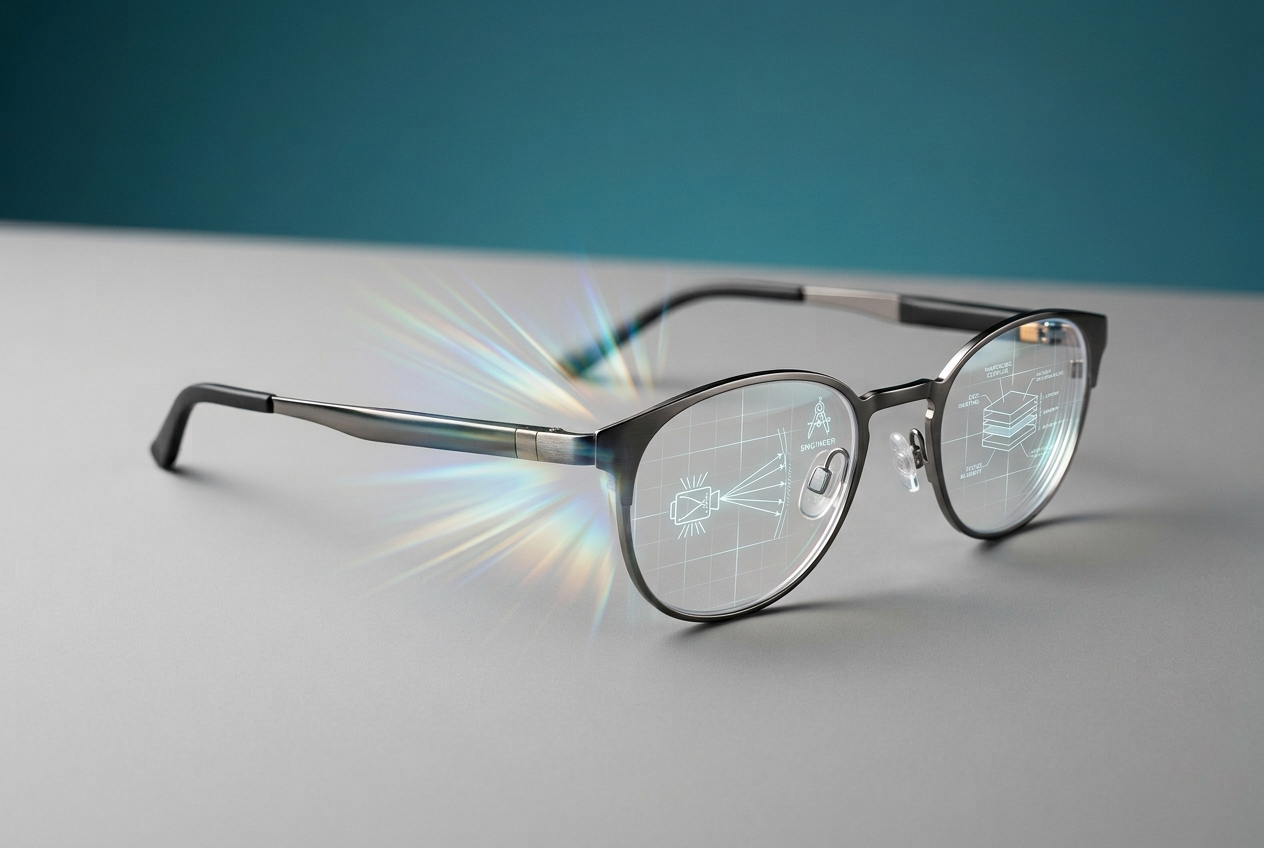
Augmented reality (AR) is transforming the way we interact with our surroundings: it makes it possible to superimpose digital information — a map, a piece of data, an image — onto what we see of the real world. Transparent (or see-through) smart glasses are the gateway to this technology, because they allow the real scene to be seen while, at the same time, projecting virtual elements onto it.
To achieve this effect, these glasses use very thin optical components called holographic optical elements. They work like tiny "light bridges": they capture the image generated by a micro-projector housed in the frame and redirect it precisely towards the user's eye, forming a virtual image superimposed on the real scene. The lens remains transparent to the rest of the light, so that the user continues to see the world normally.
The challenge arises when this idea is taken to a real product. Achieving a full-colour, bright and sharp image on a curved lens, and doing so with maximum energy efficiency, requires the hologram to make optimal use of the light. And it is precisely here that three obstacles appear which, until now, no solution on the market has resolved together:
1. Colour mismatch. The hologram is "recorded" at the factory with one colour of laser light, but the glasses' projector then uses a slightly different colour. This difference causes the image to lose brightness and sharpness.
2. Material shrinkage. During manufacture, the hologram material contracts slightly during recording and bleaching, which deforms its internal structure and shifts its point of maximum efficiency, degrading performance.
3. Lens curvature. Real glasses are not flat: the lens is curved. When the hologram is adapted to that curved surface, its optical behaviour is altered and distortions appear in the image.
Existing solutions address these problems separately and only partially — correcting one while neglecting the others — so the image continues to lose quality and manufacture is difficult to reproduce under real conditions of use. There is, therefore, a clear and as-yet unmet need: an approach that corrects all these factors at once, from the design stage itself, also capable of adapting each lens to its user's visual prescription and of maintaining high energy efficiency, and that is reproducibly manufacturable.
The Holography and Optical Processing research group (GHPO) of the University of Alicante has developed high-efficiency holographic optical elements — small components that direct light and form the image — designed specifically for integration into smart glasses. This is a versatile technology, compatible both with glasses based on holographic mirrors and with those using waveguides (the thin film that guides light inside the lens), the two main approaches on the market today.
The key lies in proprietary software, HoloTraceX, registered by the University of Alicante, which designs and optimises each hologram to measure. Thanks to it, the technology achieves:
• A sharp, colour image: it minimises optical and chromatic aberrations (the distortions that blur the image or misalign the colours).
• Personalisation for each user: it adapts the hologram to each person's prescription (myopia, astigmatism or hyperopia) and to the specific curvature of their lens.
• Low power consumption: by optimising the efficiency with which the hologram deflects light, it notably reduces the energy the device requires.
Manufacture and integration
The holograms are recorded on photopolymers (light-sensitive materials) and can be laminated directly onto the glasses' lens or manufactured separately and adhered afterwards. Once processed and "bleached" — a treatment that fixes the hologram and renders it completely transparent so that it no longer reacts to light — they no longer interfere with vision: the user sees the superimposed digital information sharply and, at the same time, the real world with complete clarity. The image comes from micro-projectors (monochromatic or RGB) located in the temple or the central bridge of the frame, and the hologram guides it towards the eye, making the most of the light.
Manufacturing process, step by step:
1. Input data: the light's angle of incidence is defined (depending on where the micro-projector is placed), together with the working wavelengths, how much the photopolymer shrinks and the lens curvature.
2. Calculation and optimisation: the HoloTraceX software processes these data and computes the optical geometry that reduces aberrations and minimises power consumption.
3. Hologram recording: it is manufactured to measure in an optical laboratory under very stable conditions (anti-vibration tables).
4. Stabilisation: bleaching fixes the recording and ensures maximum transparency.
5. Integration: it is adhered to the lens, taking advantage of the fact that the photopolymer is itself self-adhesive.
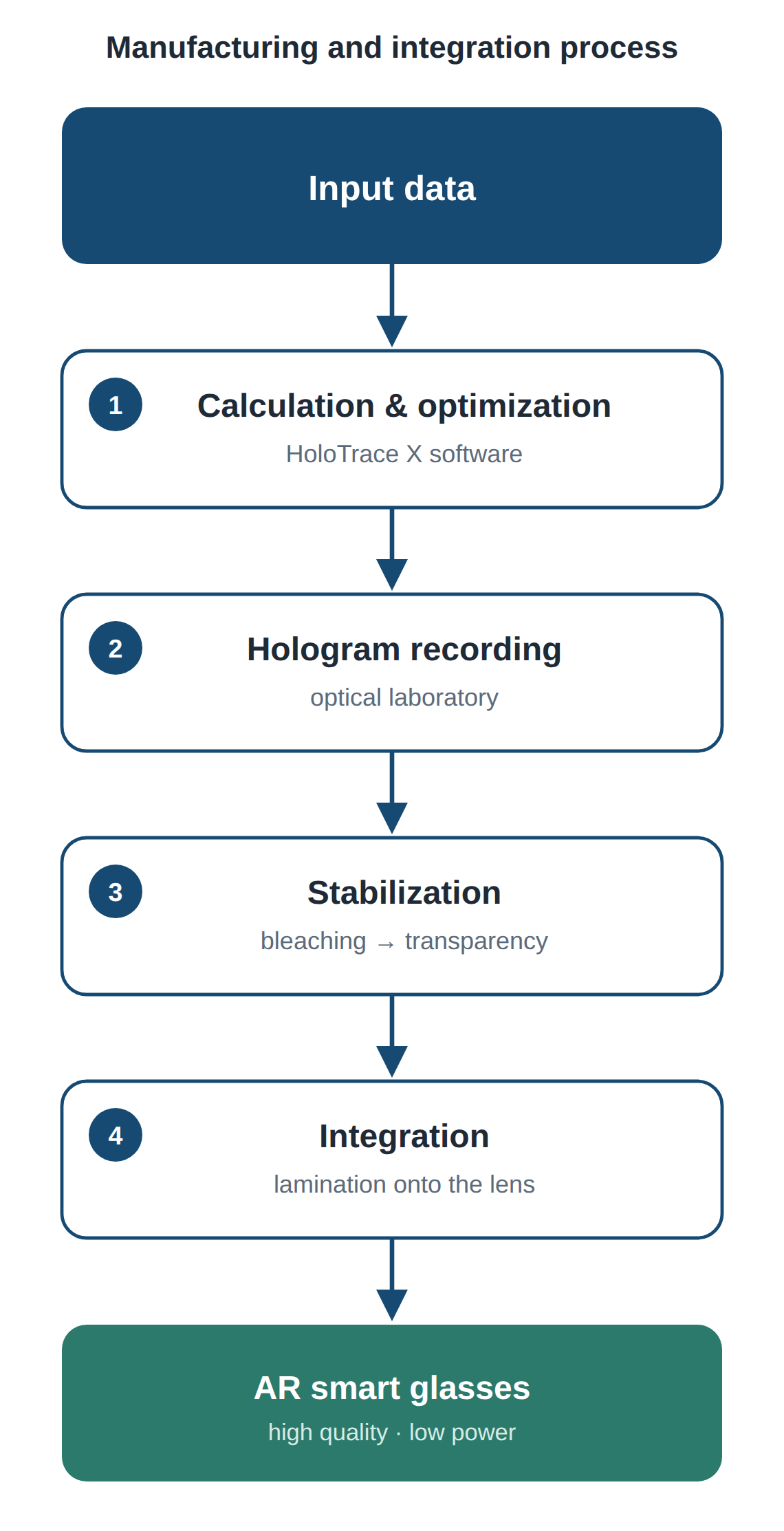
The result is smart glasses ready to deliver high-quality, low-power augmented reality.
ADVANTAGES OF THE TECHNOLOGY
The technology offers the following distinctive advantages over current solutions:
• High optical efficiency: it optimises the hologram's diffraction performance, making the most of the micro-projector's light to achieve a brighter image.
• A sharp, stable image: it corrects, from the design stage itself, the geometric and chromatic distortions caused by wavelength mismatch, material shrinkage and lens curvature.
• Integrated prescription: it incorporates the user's visual correction (myopia, astigmatism or hyperopia) into the lens itself, with no need for additional corrective lenses.
• Lightweight, discreet design: it is integrated onto curved lenses of conventional appearance, making discreet AR glasses viable instead of bulky devices.
• Integration versatility: valid both for holographic-mirror and waveguide glasses, the two main approaches on the market.
• Low power consumption: the high optical efficiency reduces the power the micro-projector requires and extends battery life.
• Proprietary design software (HoloTraceX): owned by the University of Alicante, it optimises each hologram by jointly resolving shrinkage, wavelength mismatch and curvature.
• Simple, transparent integration: the holograms are laminated directly onto the lens thanks to the self-adhesive photopolymer and become completely transparent after bleaching.
• Access to a much larger market: the integrated prescription opens AR to the huge population of people with optical prescriptions, currently poorly served by conventional AR glasses.
• Lower development cost and time: by compensating for distortions from the design stage, iterations and physical prototypes are reduced, accelerating industrialisation.
• Lower energy footprint in use: the low power consumption reduces the energy the device demands and may allow smaller batteries, using fewer materials.
• Visual inclusion and accessibility: it allows people with refractive errors to use AR glasses without uncomfortable adapters or double glasses, adding an inclusive dimension to the technology.
• Greater visual comfort: a better-corrected image, with fewer aberrations, could reduce visual fatigue during prolonged use.
INNOVATIVE ASPECTS OF THE TECHNOLOGY
The main innovative aspects of this technology are the joint compensation of all sources of distortion from the design stage itself and the encoding of the user's optical prescription within the hologram on curved lenses. Both constitute the technical foundation that makes the advantages described possible and that, to date, had not been addressed comprehensively in the prior art.
The first lies in the computational design method (HoloTraceX software). Instead of correcting each defect separately or through post-manufacture adjustments — as known solutions do — the system computes in a single step the exact microstructure that simultaneously counteracts the three physical effects that degrade the hologram under real conditions of use: material shrinkage, the difference between the recording and reconstruction wavelengths, and the deformation introduced by lens curvature. This unified, anticipatory treatment of factors traditionally considered in isolation is what is technically novel compared with existing partial pre-compensation methods.
The second consists of incorporating the user's individual optical prescription (myopia, astigmatism or hyperopia) directly into the hologram microstructure, recorded on a curved substrate. In this way, a single optical element performs at once two functions that until now required separate solutions: combining the virtual augmented-reality image and correcting the user's vision. It is precisely this joint adaptation of curvature and prescription within the hologram itself that previous techniques did not resolve, focused as they were on flat surfaces and without refractive personalisation.
The technology has been developed at laboratory scale (TRL 4/5).
The technology is aimed at manufacturing holographic optical elements for augmented-reality smart glasses, with direct application in:
• Consumer electronics: AR smart glasses for everyday use.
• Ophthalmic optics and eyewear: AR glasses with the user's prescription integrated into the lens itself.
• Industrial and professional augmented reality: hands-free superimposed information in manufacturing, logistics or maintenance.
Additional potential uses:
• Healthcare and clinical AR: superimposed visualisation as support in surgery or medical assistance.
• Automotive and transport: transparent holographic combiners of the head-up display (HUD) type.
• Defence and aeronautics: visors and helmets with integrated visualisation (head-mounted displays).
• Sport: athletes can view biomedical data on their glasses — heart rate, power output (watts), etc.
The University of Alicante is seeking companies interested in incorporating this technology into their products and exploiting it commercially. Avenues of collaboration include:
• Licence agreements for the patent and the HoloTraceX software for its industrial development and commercialisation.
• R&D collaboration for the adaptation and development of the technology through to prototype validation and its integration into a product.
• Scientific and technical advice from the research team.
In particular, collaborations will be welcomed with:
• Manufacturers of smart glasses and augmented-reality devices.
• Companies in the ophthalmic-optics and eyewear sector.
• Manufacturers of optical components and holographic elements.
• Integrators of augmented-reality solutions for industrial and professional environments.
This technology is protected by two patent applications and one software registration:
• Title of patent application 1: “RGB waveguide display system with multiplexed holograms”.
• Application number 1: P202630910
• Filing date 1: 23 June 2026
• Title of patent application 2: “Compensated holographic optical element for augmented reality on curved substrates”.
• Application number 2: P202630930
• Filing date 2: 26 June 2026
• Software name: HoloTraceX
• Registration number: RUA 162649
• Registration date: 3 February 2026


Carretera San Vicente del Raspeig s/n - 03690 San Vicente del Raspeig - Alicante
Tel.: (+34) 965 90 9959