
Can we help you?
Contact us

Can we help you?
Contact us
Thank you for contacting us
Your form has been submitted successfully Our team will contact you again as soon as possible.
Whooppss...!! An error has occurred
Try sending later or write an email directly to areaempresas@ua.es

INFO
SHEET
DOWNLOAD
EXECUTIVE
ABSTRACT
CONTACT DETAILS: Research Results Transfer Office-OTRI
University of Alicante
Tel.: +34 96 590 99 59
Email: areaempresas@ua.es
http://innoua.ua.es
The Health, Physical Activity and Sports Technology (HEALTH-TECH) research group at the University of Alicante has developed a new weight bar lifting device for gyms. By applying the principle of a second-class lever, this device makes it easier to load and unload weights without the user having to lift the bar manually from the floor. Consequently, during strength training, this would help to avoid the risk of lower back injuries, reduce the time needed to change discs and improve safety regardless of the user’s characteristics, the magnitude of the load or the environmental conditions.
The researchers are seeking fitness equipment manufacturers interested in exploiting and marketing the device through licensing agreements.
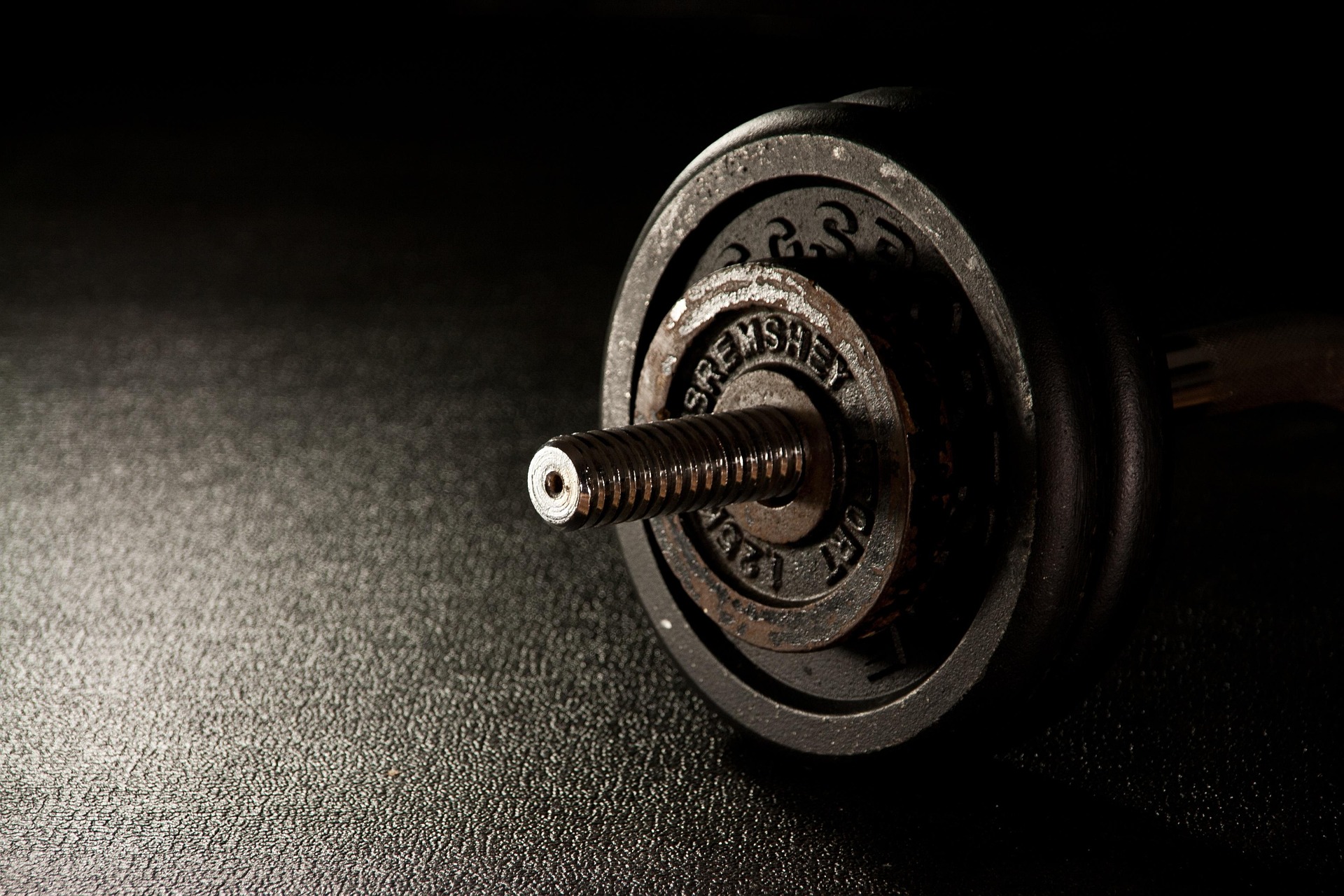
Free weightlifting is a widely used training method in disciplines such as weightlifting, powerlifting, CrossFit, and fitness. In exercises where the loaded barbell remains on the ground, such as deadlifts, Olympic lifts, or hip thrusts, a problem arises related to the need to modify the load by adding and removing weight plates.
The conventional solution involves manually lifting one end of the barbell while manipulating the plates with the free hand. This procedure presents significant biomechanical drawbacks, as it can contribute to the development of herniated discs, bulges, ligament injuries, and lower back pain. Furthermore, the arm holding the barbell must generate a high gripping force, involving intense activation of the wrist and finger flexors and the biceps brachii, which increases the risk of tendinopathies and tendon ruptures.
When the loads are heavy, as is the case with advanced athletes, manual lifting can exceed the user's physical capabilities, especially in situations of fatigue. This increases the risk of losing control of the bar, with potential damage to the equipment or crush injuries to the lower extremities.
From an operational standpoint, the process of lifting the bar, changing weight plates, and lowering it back down can take between 30 and 90 seconds per end. In a session with multiple weight changes, this time can add up to 5 to 12 minutes of auxiliary work that doesn't directly contribute to the training.
Currently, there are several solutions on the market, grouped into four categories:
1. Load wedges: rubber pieces on which the bar rolls to slightly raise the weight plate and facilitate weight changes. However, they don't provide a mechanical advantage, as the user must directly overcome rolling resistance and gravity.
2. Full barbell jacks: devices that lift the entire barbell simultaneously. However, they are bulky, heavy, and expensive, limiting their use to fixed facilities.
3. Mini barbell jacks: these are notable for their portability and allow each athlete to have their own device. However, they also lack a lever mechanism to multiply the applied force, so the user must still manually lift the bar to place it on the rack.
4. Oversized plates: These are placed first and act as a support point on the floor, allowing for the exchange of smaller diameter plates without interference. Their main drawback is their lack of universality, as they require the user to add an additional, specific component.
Therefore, there is a need for a barbell lifting device that improves ergonomics, safety, and efficiency during loading and unloading operations. This device should allow for a temporary and stable lifting of the barbell, preventing the plates from contacting the floor and significantly reducing the physical effort required to change the weights.
This is a manual mechanical device, consisting of a sturdy metal frame, whose main function is to raise a bar loaded with discs using the principle of a second-class lever, making it easier to load and unload weights without the user having to lift the bar manually from the floor. It consists mainly of the following parts (see Figure 1):
• Loading base (foot): This is the lower horizontal element. It acts as the point of contact with the floor and provides the necessary stability. Its flat design allows the device to stand upright on its own when not in use. Furthermore, the extension of the base, beneath the lever arm, allows the device to be secured with the foot during the loading manoeuvre, to facilitate the manoeuvre and also provide stability to the device.
• Vertical Column (Main Mast): A central tubular profile that rises perpendicularly from the base. It is the structural axis that supports the load.
• Load-bearing bracket (fork/cradle): Located at the top of the vertical column. It is shaped like an upward-opening ‘U’ or ‘C’. Its function is to receive and cradle the bar.
• Lever Arm (Handle): An elongated tube extending vertically, parallel to the main column but offset towards the rear by means of an elbow or horizontal connection. Its length is critical for generating mechanical advantage and, in this way, providing greater and better mechanical advantage or facilitating improved ergonomics for users by reducing the need to bend down so far.
• Front Attack Zone: A structure made from the same material, width and thickness as the support base. It has an initial angle of 145° or 55° from the vertical, providing the necessary and precise angle to engage with the bar before lifting. It also serves a dual purpose, acting as a carrying handle and grip for transport.
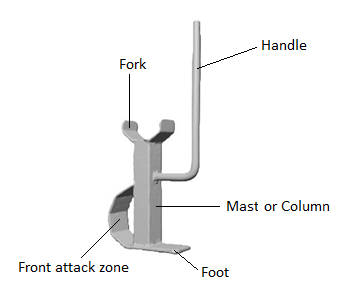
Figure 1: Perspective view of the weightlifting bar lift device
MAIN ADVANTAGES OF THE TECHNOLOGY
The main advantages of this technology are as follows:
• It eliminates the need to apply manual lifting force and replaces positions involving lumbar flexion with a biomechanically neutral upright posture, thereby eliminating the risk of injuries such as herniated discs, disc protrusions, ligament injuries and chronic lower back pain.
• It increases user safety; for example, it eliminates the risk of suddenly losing control of the bar when, under conditions of fatigue, high weights are lifted. This prevents the risk of impact with the floor, damage to equipment or crush injuries to the lower limbs.
• It improves efficiency by reducing the time spent changing discs by more than 50%. Typically, this can take between thirty and ninety seconds per end of the bar; in a session involving multiple load changes, the cumulative time can amount to between five and twelve minutes of non-productive auxiliary work.
INNOVATIVE ASPECTS
Unlike other commercial devices, the present invention maximises the mechanical advantage through a specific geometric configuration in which the length of the power arm is significantly greater than the length of the resistance arm. Thus, the structure is configured to rotate about a dynamic pivot point fixed to the main column of the invention. This feature ensures that, during operation, the stability of the assembly’s centre of gravity is maintained throughout the entire movement, thanks to its width.
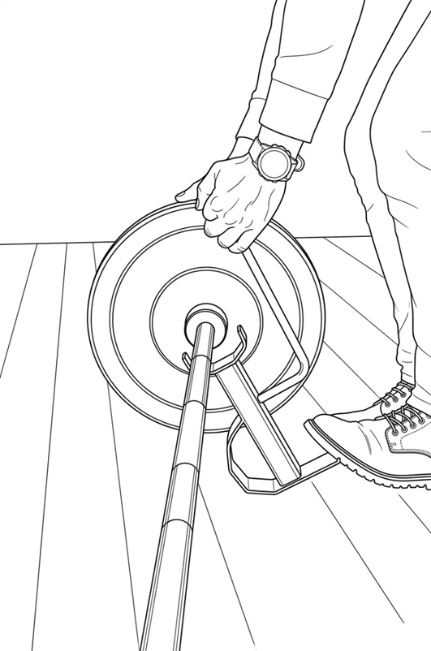
Figure 2: View of the device in use
A prototype of the device is available and has already been tested by end users.
It is primarily aimed at the personal training and fitness sector, including gyms, training boxes, high-performance centres and home settings, where heavy weights are frequently used and compatibility with different types of bars and discs is required.
We are seeking fitness equipment manufacturers interested in exploiting and marketing the device through licensing agreements.
This technology is protected by patent application:
• Patent title: “Dispositivo elevador de barras con pesas de gimnasio”.
• Application number: P202630597
• Application date: 22/04/2026


Carretera San Vicente del Raspeig s/n - 03690 San Vicente del Raspeig - Alicante
Tel.: (+34) 965 90 9959