
Can we help you?
Contact us

Can we help you?
Contact us
Thank you for contacting us
Your form has been submitted successfully Our team will contact you again as soon as possible.
Whooppss...!! An error has occurred
Try sending later or write an email directly to areaempresas@ua.es

INFO
SHEET
DOWNLOAD
EXECUTIVE
ABSTRACT
CONTACT DETAILS: Research Results Transfer Office-OTRI
University of Alicante
Tel.: +34 96 590 99 59
Email: areaempresas@ua.es
http://innoua.ua.es
The Joint Research Unit for Biomedical Design and Manufacturing (BioFab), comprising researchers from the University of Alicante and the Alicante Institute for Health and Biomedical Research (ISABIAL), has developed a new model of 3D-printed orthosis to immobilise a limb following an injury and aid its recovery. This device consists of a rigid, biodegradable, low-temperature thermoformable inner structure, covered by a flexible outer layer that is biocompatible with the skin.
BioFab is seeking manufacturers of rehabilitation products interested in validating and commercialising it (through licensing agreements) or in designing other new devices.
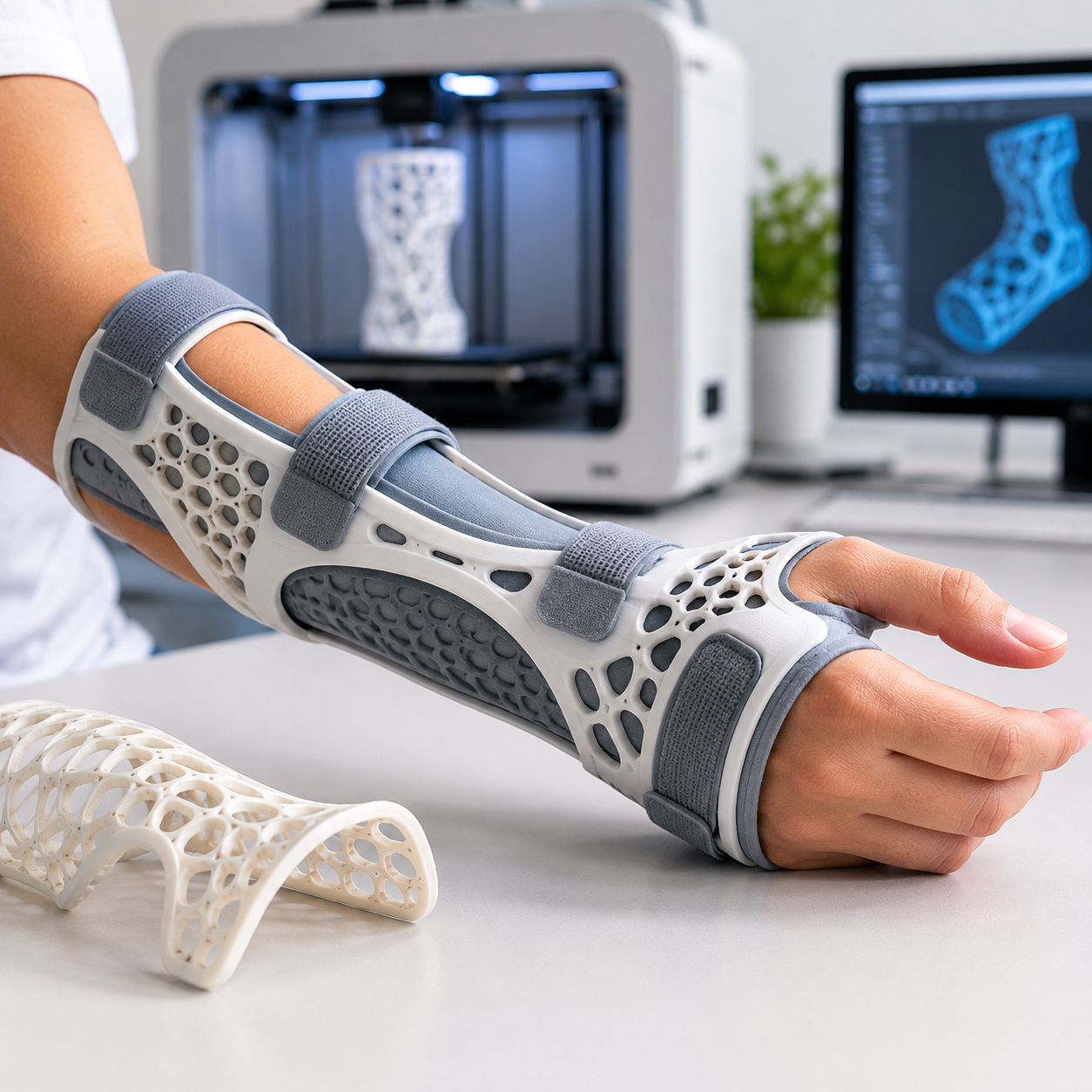
Currently, the standard treatment for limb immobilization following a fracture or orthopedic surgery involves the use of plaster casts or synthetic materials, such as polyester resins or fiberglass, as orthoses. These systems maintain the bone in the correct position during the healing process, which typically lasts between 4 and 8 weeks depending on the location and severity of the injury. However, between 15% and 30% of patients experience complications associated with this type of immobilization, such as thermal injuries, muscle atrophy, contact dermatitis, pressure ulcers, or wounds. These complications can prolong recovery, increase healthcare costs, and require additional treatments.
Orthoses are used especially in traumatology and rehabilitation to prevent problems arising from improper positioning or alignment, both before and after surgery. They also aim to preserve the limb's functional capacity and promote healing. Since immobilization needs can vary during treatment, the orthosis's characteristics must be adapted to each phase to maintain stability and optimize functionality.
Conventional techniques use rigid splints or casts that completely immobilize the treated area, which is not always necessary. Their application requires activating the material's hardening process with water, molding it to the patient's anatomy, and securing it with an elastic bandage.
These devices have several limitations: they are rigid, heavy, and poorly adaptable to different phases of treatment or complex anatomical geometries; they degrade with moisture, hindering patient hygiene; and their poor breathability promotes irritation, dermatitis, skin maceration, microbial proliferation, and pressure points that can lead to infections or delayed healing.
On the other hand, non-conventional manufacturing processes usually require the prior manufacture of a mold, which increases production costs and lengthens the time from the design and customization phase to the marketing and application of the orthosis in the end user.
This new thermoformed device, produced using additive manufacturing (Figure 1), essentially consists of two parts:
• The flexible, insulating, adaptable outer protective cover, which is biocompatible with the skin (Figure 1-a).
• The rigid inner structure, which is biodegradable and thermoformable at low temperatures (Figure 1-b).
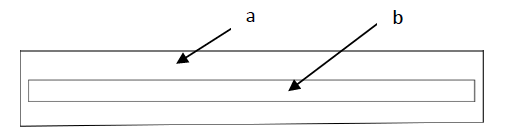
Figure 1: Close-up of the section of the material printed using additive manufacturing
The general procedure for applying the device is as follows:
• Stage 1: Key reference measurements are taken to assess the patient’s anatomy. These measurements must take into account the area to be aligned or treated, as well as those areas that must be left free—for example, to avoid restricting mobility or to ensure that a wound requiring monitoring is not covered.
• Stage 2: Once the reference measurements have been obtained, the customised 3D preform is designed using CAD software.
• Stage 3: The 3D model file is exported to slicing software for additive manufacturing.
• Stage 4: The 3D preform produced via additive manufacturing is heated to thermoform it and adapt it to the patient’s anatomy. The temperature required is low and does not cause burns to the patient.
• Stage 5: Once the 3D preform has been adapted to the patient’s anatomy, it is adjusted and secured using the system specified in the device’s design. This means that if the treated area becomes inflamed due to the injury itself, or conversely, if the inflammation subsides after 3–4 days, the same device can be readjusted and secured without needing to be replaced. This is of great clinical importance as it avoids the need for surgical intervention.
MAIN ADVANTAGES OF THE TECHNOLOGY
It is worth highlighting the numerous advantages of the device:
• This general procedure takes approximately 24–48 hours for stages 1 to 3, that is, from the time the key reference measurements are taken to assess the patient’s anatomy until the 3D preform is obtained. However, the invention offers the advantage that, for emergency situations, standard 3D preforms printed in different sizes can be kept in stock, allowing the process to proceed directly to phase 4 of thermoforming, followed by adjustment and fixation to the patient’s anatomy.
• Significant scope for creative scalability by the user and/or clinician to incorporate gadgets offering new functionalities, for example, biomedical data monitors; to integrate regenerative skin biomaterials or any other material for medical or therapeutic purposes.
• Unlike other devices, it is composed of two materials with distinct functions but produced in a single stage.
• It has good moisture resistance, meaning the device can be washed or submerged in water, allowing the patient to shower or use it in aquatic environments.
• It can be shaped to any geometry, adapting to complex patient anatomy such as knees or elbows. Furthermore, it allows for unlimited designs that make it easy to leave parts of the anatomy exposed where mobility is required or where the area should not be covered to facilitate healing or prevent potential complications.
• This 3D preform, produced directly via additive manufacturing, does not necessarily have to be coplanar; in other words, it allows for variations in thickness across the plane to, for example, integrate reinforcements or the fastening elements themselves into the orthosis.
• The unlimited designs of the 3D preform of the invention allow areas to be left uncovered to provide access to wounds or parts of the anatomy requiring treatment. This is particularly useful in post-surgical immobilisation, as it prevents infections and facilitates access for wound care.
• The orthosis is designed to be easily adjusted and secured, allowing it to be adapted as the patient heals; it can be removed, trimmed and adjusted to suit the healing process, and can even be reused.
INNOVATIVE ASPECTS
Additive manufacturing technology enables the thermoformed orthosis:
• Do not require pre-processing or mould-making. It simply involves the direct production of a 3D preform for the end user based on a design modelled in 3D software.
• It is a clean and rapid process that allows the 3D preform to be printed in any geometry and to use materials that provide the optimal properties so that the device of the invention fulfils the functionalities required for the treatment of the patient’s anatomy.
• Manufacturing costs are low, which facilitates the production of the devices within the hospital itself.
• Standard thermoformed devices of different sizes can be manufactured for more common applications or functions.
• The 3D preforms produced using additive manufacturing can be easily cut and adapted to the patient’s anatomy.
• Continuous advances in this technology and in materials improve comfort, rigidity, adaptability and mechanical properties that are not currently met.
A prototype of the orthosis has been developed and has already been approved by its end users.
It is primarily aimed at the physiotherapy and occupational therapy sector, that is to say, the professionals working in public and private healthcare centres who are dedicated to the physical and functional rehabilitation of people who have suffered an injury.
We are seeking manufacturers of rehabilitation products who are interested in validating and commercialising this product (through licensing agreements) or in designing new devices.
This technology is protected by patent application:
• Patent title: “Dispositivo de rehabilitación de un paciente y método de fabricación”
• Application number: P202531265
• Application date: 29/12/2025


Carretera San Vicente del Raspeig s/n - 03690 San Vicente del Raspeig - Alicante
Tel.: (+34) 965 90 9959