
Can we help you?
Contact us

Can we help you?
Contact us
Thank you for contacting us
Your form has been submitted successfully Our team will contact you again as soon as possible.
Whooppss...!! An error has occurred
Try sending later or write an email directly to areaempresas@ua.es

INFO
SHEET
DOWNLOAD
EXECUTIVE
ABSTRACT
CONTACT DETAILS: Research Results Transfer Office-OTRI
University of Alicante
Tel.: +34 96 590 99 59
Email: areaempresas@ua.es
http://innoua.ua.es
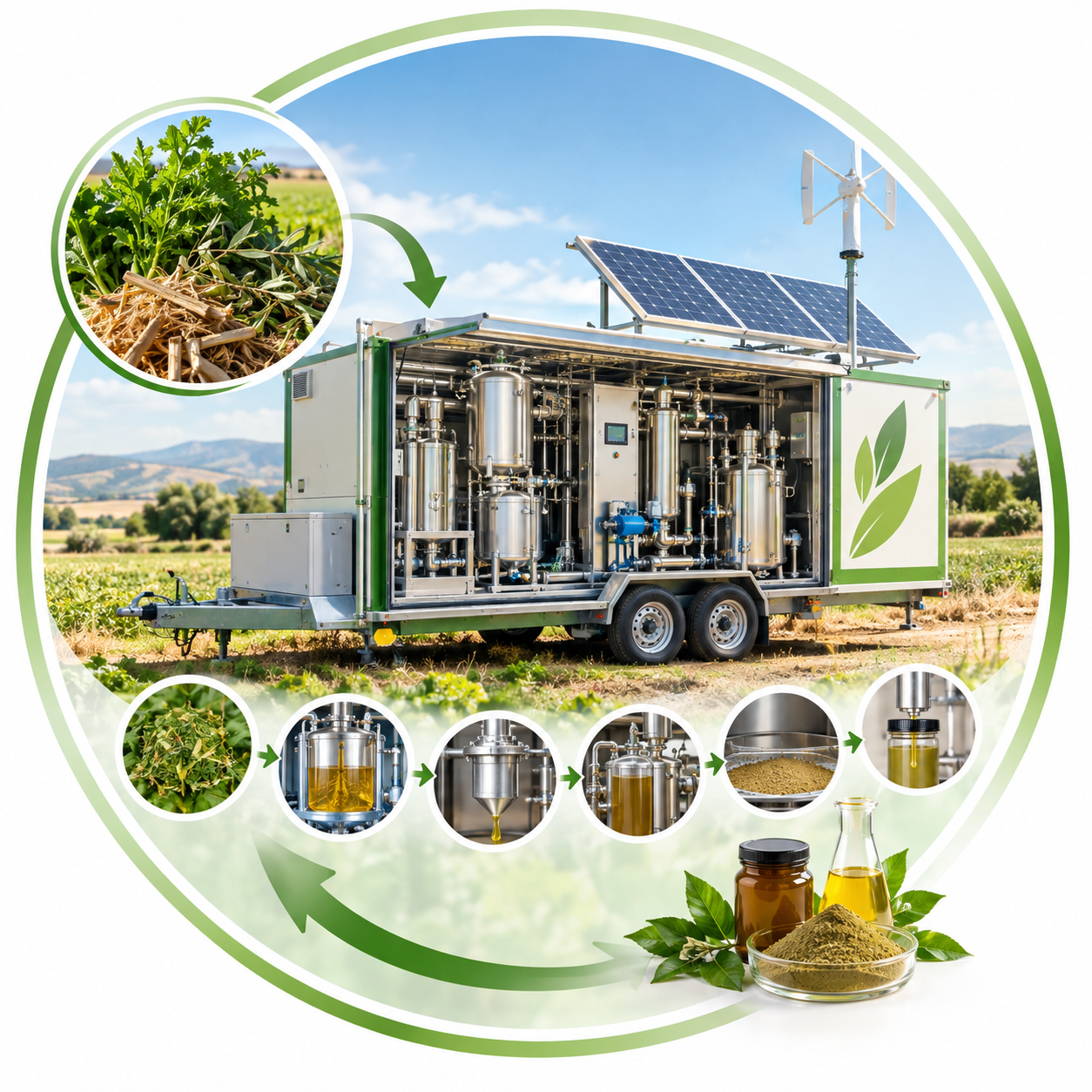
The research group "Química (bio)Analítica y Circular" (bioCir) of the University of Alicante has developed a mobile, compact and autonomous unit for the in situ processing of fresh plant biomass and agricultural by-products, making it possible to obtain high-value bioactive extracts directly at the place of cultivation or where the residue is generated.
The technology integrates within a single transportable platform all the stages of the process —conditioning, assisted extraction, separation, concentration, drying and packaging— and is designed to operate with energy autonomy from renewable sources and with a closed-loop solvent-recovery circuit. Its design also enables cascade extraction, in which the solid residue is automatically redirected in order to chain successive extractions and make the most of the biomass. By processing the freshly harvested material in the field, the transport of large quantities of water is avoided and the degradation of the fresh material is halted, yielding a final product that is dry, stable and ready for use.
The technology, protected by a patent application, has been developed at laboratory scale, where the process has been validated on various real agro-industrial by-products, such as olive leaf, grape pomace and pineapple by-products. The extracts obtained are applicable in the functional food, nutraceutical, cosmetic, pharmaceutical and biostimulant sectors. Companies interested in its commercial exploitation are sought.
The valorisation of plant biomass and agricultural by-products —that is, their transformation into value-added products— is today carried out mainly in fixed industrial facilities. This centralised model requires the raw material to be moved from the field to the processing plant and faces two critical barriers: high logistics costs and a rapid loss of quality of the raw material.
The first barrier originates in water. Freshly harvested biomass has a high moisture content, usually above 60–80% of its weight. Transporting that volume of water to plants far from the point of cultivation considerably increases the cost of the process: logistics costs may account for between 30% and 70% of the total processing cost, depending on the distance.
The second barrier is the deterioration of the raw material itself. Prior transport and storage introduce waiting times ranging from several hours to several days and, during that interval, the biomass degrades rapidly through oxidation, through microbial growth and through the plant's own enzymatic activity (internal processes that continue after harvesting). This degradation can reduce the content of bioactive compounds —the high-value molecules to be recovered— by between 20% and 50%. In addition, the natural variability of the biomass and its rapid deterioration make it difficult to standardise the process in traditional factories, which compromises the reproducibility and quality of the final product.
To exploit these resources, numerous extraction methods are known, ranging from the use of solvents to intensified techniques —such as ultrasound or microwaves— that accelerate the release of the components of interest. Once the extract has been obtained, drying and stabilisation technologies, such as freeze-drying or spray-drying, are used to preserve the product. However, practically all of these technologies are designed for fixed facilities, since they depend on complex energy infrastructures that prevent their direct use in the field itself.
As an alternative, modular or decentralised biorefineries have been proposed, but those described to date are oriented towards urban environments, are neither mobile nor autonomous for operating in the field, and are not designed to treat fresh agricultural biomass or to incorporate advanced drying. The truly mobile systems that currently exist, for their part, focus almost exclusively on the energy valorisation of biomass. And those mobile units that do extract compounds usually generate only concentrated liquid extracts which, lacking a solid-drying system within the unit itself, remain unstable and difficult to preserve. Others, moreover, necessarily depend on a connection to the electricity grid or are limited to separating basic fractions —fibres or simple sugars— instead of obtaining already-purified bioactive compounds.
There is, therefore, a technological gap in current systems, which solve the problem only partially. A genuinely mobile technology is needed, able to travel to the place of cultivation in order to process the fresh biomass immediately after harvesting, and energy-autonomous, integrating within a single unit and in a coordinated manner all the stages of the process: extraction, separation, concentration and drying of the extract. Only a solution with these characteristics would make it possible to halt the degradation of the compounds of interest, avoid the costly transport of water and obtain —directly in the field— a final product that is dry, stable and ready for commercialisation.
The research group "Química (bio)Analítica y Circular" (bioCir) of the University of Alicante has developed a compact, mobile and transportable system for processing fresh plant biomass and agricultural by-products in situ, that is, in the very place where they are generated or harvested. Within a single platform, all the stages required to transform the freshly harvested raw material into a usable extract are integrated in an orderly manner: conditioning, extraction of the compounds of interest, separation, concentration and packaging. The system is designed to operate with its own energy autonomy from renewable energy and to manage the solvent in a closed loop, without depending on external connections.
The assembly is mounted on a transportable platform —of the trailer or container type, with dimensions compatible with standard transport. The various modules are arranged in line along the platform, in the same order in which the material advances during the process, and are physically connected to one another by means of conduits, valves, pumps and mechanical solids-transfer systems. In this way, the material passes directly from one stage to the next within the unit itself, without intermediate manual handling.
The system comprises the following modules, integrated sequentially and functionally:
• Pre-treatment: mills the fresh biomass to reduce its size and condition it for extraction.
• Extraction: a reactor in which the biomass is brought into contact with a solvent with the aid of an assisted-extraction technique. It is adaptable to different methods according to the type of plant material.
• Solid–liquid separation: divides the mixture leaving the reactor into two streams, a liquid one (the extract) and a solid residue (the spent biomass), by means of filtration, pressing or centrifugation.
• Solvent concentration and recovery: evaporates and removes the solvent from the extract in order to concentrate the product of interest.
• Solvent storage and recirculation: tanks which, together with the previous module, form a closed loop; the recovered solvent is automatically returned to the reactor to be used again in new cycles.
• Stabilisation or drying (optional): dehydrates the concentrated extract to obtain a dry solid, preferably a powder.
• Packaging: doses, temporarily stores and packages the final product.
• Autonomous energy supply: an assembly for capturing and storing renewable energy (photovoltaic panels, batteries and inverters), sized to power the entire unit without connection to the electricity grid.
• Control and automation: a centralised electronic system that monitors and regulates the conditions of each module in real time and selectively adjusts or halts the stages according to the available energy.
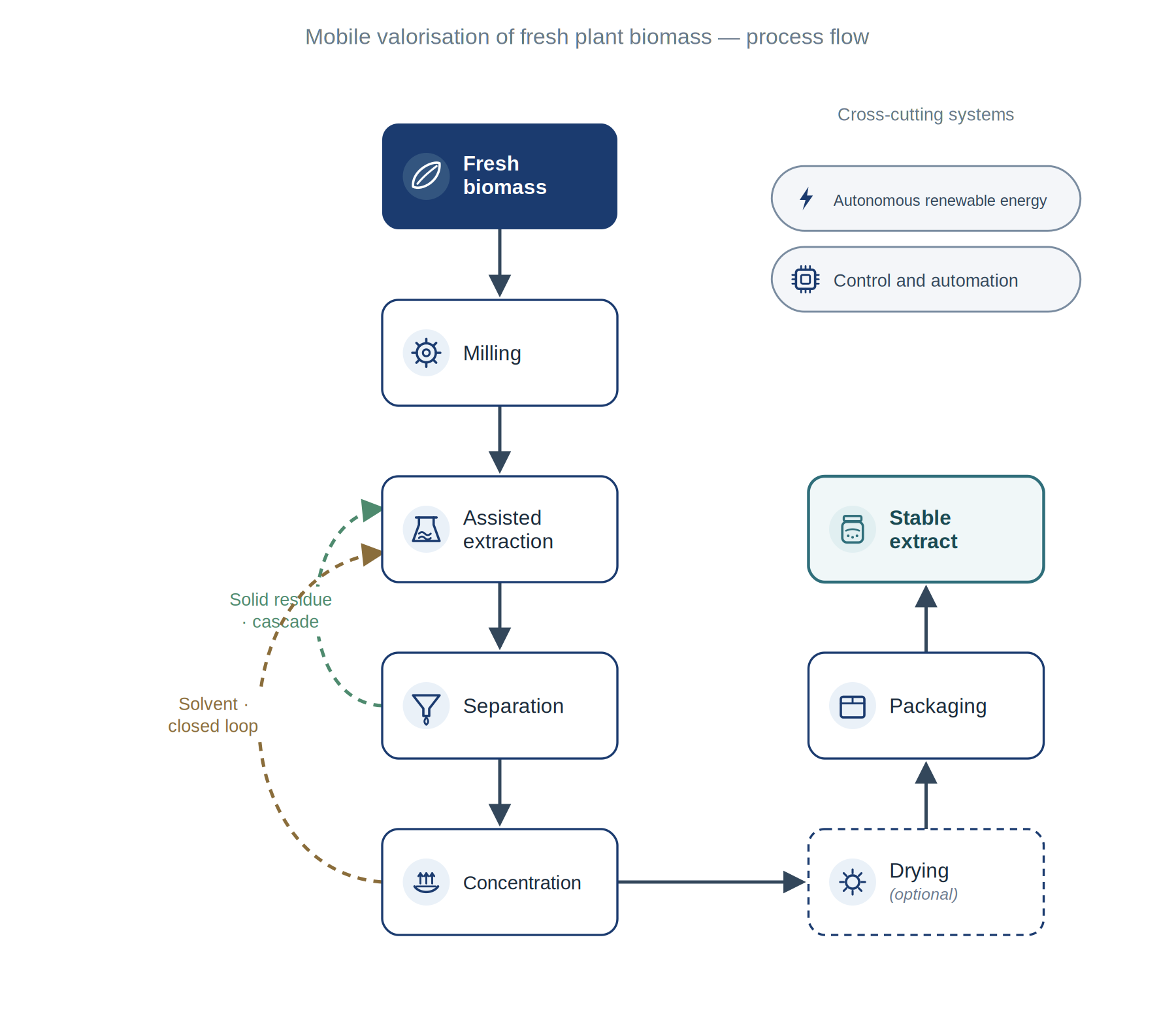
Operation begins with the loading of the biomass into the pre-treatment module. Once milled, it is automatically transferred to the reactor, where it is mixed with the solvent by means of assisted extraction; the mixture then passes to the separator, which divides it into the liquid extract —intended for concentration and packaging— and the solid residue.
A central feature of the system is its capacity to carry out "cascade" extraction in an integrated manner within the unit itself. In this mode, after a first extraction with an initial solvent (for example, to recover phenolic compounds), the solid residue leaving the separator is automatically redirected back to the reactor, where it is brought into contact with a second, different solvent to extract other families of compounds (for example, chlorophyll pigments). The material passes through the separator again, and the cycle is repeated until the plant matrix is fully exploited. All of this takes place internally and in a coordinated manner, without external transfers or manual handling.
Lastly, the system can operate both continuously and in batches, adapting to the needs of each application.
ADVANTAGES OF THE TECHNOLOGY
Compared with extraction in fixed centralised facilities and with conventional portable equipment, this mobile unit offers the following advantages:
• Eliminates logistics dependence and its costs: by processing the freshly harvested biomass in the field itself, the transport of large quantities of water is avoided (fresh material usually contains 60–80% moisture) and transport costs —which in centralised models can amount to between 30% and 70% of the total cost— are eliminated.
• Preserves the quality and reproducibility of the extract: by minimising the time between harvesting and processing, the degradation (enzymatic, microbial and oxidative) that fresh material undergoes during transport and storage —capable of reducing the compounds of interest by between 20% and 50%— is halted, which translates into a higher-quality and more reproducible extract.
• Makes the most of the biomass (cascade extraction): the system chains several extractions on the same material automatically; the first conditions the plant matrix and improves the yield of the next, so that several value fractions are obtained from a single biomass and the overall yield increases.
• Energy autonomy with intelligent management: it operates without connection to the electricity grid thanks to its own renewable supply, and its control system adjusts or prioritises the stages according to the available energy, which makes it possible to operate in isolated areas or those with limited resources.
• Sustainability — closed-loop solvent: the extraction solvent is recovered and reused internally, reducing its consumption, losses and emissions to the exterior.
• Final product that is dry, stable and ready to be marketed: unlike mobile equipment that obtains only liquid extracts (unstable and perishable), this unit can incorporate a drying step that transforms the extract into a solid —preferably a powder— of greater stability and shelf life, suitable for direct distribution from source.
• Notably reduces extraction times: the use of assisted-extraction techniques makes it possible to obtain the extract in a fraction of the time required by traditional solid–liquid methods (usually 30–60 minutes).
• Flexibility of operation and scaling: the possibility of working continuously or in batches and of sizing the equipment at pilot or semi-industrial scale.
• Versatility of application: being adaptable to different types of biomass and target compounds, a single platform could serve several crops and products.
• Lower carbon footprint: avoiding the transport of moist biomass and using renewable energy points to a reduction in the carbon footprint of the process.
• Revalorisation of by-products on site: it transforms an agricultural residue —whose management is usually a cost— into a value-added product obtained in the field itself, opening up a possible new source of income.
INNOVATIVE ASPECTS OF THE TECHNOLOGY
The main innovative aspects of this technology are two: on the one hand, the integration of the entire processing line —from the fresh biomass to the dry product— within a single mobile and energy-autonomous platform; and, on the other, an automatic solid-residue return mechanism that makes integrated cascade extraction possible, without manual intervention.
The first aspect is the complete integration of the process within a mobile, autonomous unit. What is technically new is not each stage on its own —extracting, separating, concentrating or drying are known operations— but rather that all of them are physically linked and coordinated within a single unit capable of operating in the field itself, without connection to the grid. It is this integration that makes it possible to obtain a stable final product directly on site, something that earlier mobile systems did not achieve, as they were limited to partial operations or to liquid extracts. Moreover, because the biomass is processed in the very place where it is generated, the transport of large quantities of moist material is avoided and the by-product is transformed into a higher-value product in the field.
The second aspect is the automatic return of the solid residue to the reactor in order to chain extractions. In the usual methods, the plant material is discarded or treated separately after a first extraction; here, by contrast, it is automatically redirected to be subjected to a second solvent within the same cycle. The key lies in the fact that the first extraction modifies the structure of the plant matrix and facilitates the next, so that this chaining not only automates the process but also increases the overall recovery yield.
At present, the process has been validated at laboratory scale, while the integrated mobile prototype is pending assembly at pilot scale. In this validation, various real agro-industrial by-products —of high moisture content and rapid deterioration— have been processed, obtaining extracts of stable and reproducible composition, suitable as high-value ingredients for the food, pharmaceutical, cosmetic and biostimulant sectors.
Matrices with which the process has been validated:
• Pineapple by-products (food-processing industry), as a very-high-moisture residue: antioxidant extracts rich in polyphenols were obtained, with good reproducibility.
• Olive leaf (pruning residues): made it possible to validate integrated cascade extraction, recovering several families of compounds from a single biomass sequentially.
• Grape pomace (winemaking by-product): its immediate processing after generation prevented the oxidation and fermentation of the fresh material, allowing stable polyphenolic extracts to be obtained.
The next step envisaged is the assembly of the integrated prototype at pilot scale and its subsequent semi-industrial scaling, a stage for which industrial collaboration is sought.
This technology falls within the field of applied chemical engineering and the valorisation of plant biomass, specifically within mobile systems for the in situ processing of agricultural by-products and the obtaining of bioactive extracts. Owing to its cross-cutting nature, it is of interest both to the sectors that generate the biomass —potential users of the equipment— and to the target markets for the extracts obtained.
Biomass-generating sectors:
• Olive-oil sector and olive mills: pruning residues and by-products of the olive grove.
• Wine industry and wineries: pomace and winemaking by-products.
• Fruit and vegetable processing industry: high-moisture by-products, such as those derived from pineapple.
• Agricultural holdings, cooperatives and managers of agro-industrial by-products: valorisation of plant residues in the very place where they are generated.
Target markets for the extracts:
• Functional foods and nutraceuticals: antioxidant ingredients of natural origin.
• Cosmetics and dermatological pharmacy: active ingredients of plant origin.
• Pharmaceutical industry: bioactive compounds of interest.
• Biostimulants and crop protection: plant-based agricultural formulations.
• Cleaning and household-care products: ingredients of natural origin.
Additional potential uses:
• Natural pigments and colourants: cascade operation would make it possible to recover, in addition to the antioxidants, pigment fractions (e.g. chlorophyll) of interest as natural colourants.
• Other high-moisture agro-industrial by-products: possible extension to matrices such as citrus, tomato, spent coffee grounds or brewers' spent grain, among others.
• Active packaging and natural preservatives: use of the antioxidant extracts as additives to extend the preservation of foods.
The bioCir research group of the University of Alicante is seeking companies interested in incorporating this technology into their processes or in taking part in the subsequent stages of development and validation, by means of one of the following arrangements:
• Patent licence: assignment of the rights to use the technology to companies with the capacity for its implementation and commercial exploitation.
• Technology transfer: transmission of the associated technical knowledge (know-how) and of the support needed for its correct implementation in the partner’s production environment.
• Joint research and proof of concept: collaboration for the assembly and validation of the integrated prototype at pilot scale and its subsequent scaling, as well as for the adaptation of the unit to the specific needs of the company. Given that the technology is at laboratory scale, this is the priority route in the short term.
Main areas of collaboration:
• Assembly and validation of the integrated prototype at pilot scale.
• Semi-industrial scaling of the mobile unit.
• Adaptation of the system to the by-products and plant matrices of interest to the partner.
• Optimisation of the processing line (assisted extraction, cascade extraction and drying) for specific products.
• Development of ingredients and formulations from the extracts obtained.
Company profiles sought:
• The olive-oil sector and olive mills, wineries and the wine industry, and the fruit and vegetable processing industry, as generators of biomass and potential users of the equipment.
• Agricultural cooperatives and managers of agro-industrial by-products interested in valorising their residues on site.
• Engineering companies and manufacturers of process equipment or agricultural machinery, for the development and production of the unit.
• Companies in the functional food, nutraceutical, cosmetic and pharmaceutical fields, as well as in biostimulants, crop protection and natural-based cleaning products, as target markets for the extracts.
• Patent title: «Sistema compacto para valorización in situ de biomasa vegetal y obtención de extractos bioactivos» — "Compact system for the in situ valorisation of plant biomass and the obtaining of bioactive extracts" (unofficial translation).
• Application number: P202631056.
• Filing date: 21 July 2026.


Carretera San Vicente del Raspeig s/n - 03690 San Vicente del Raspeig - Alicante
Tel.: (+34) 965 90 9959