
Can we help you?
Contact us

Can we help you?
Contact us
Thank you for contacting us
Your form has been submitted successfully Our team will contact you again as soon as possible.
Whooppss...!! An error has occurred
Try sending later or write an email directly to areaempresas@ua.es

INFO
SHEET
DOWNLOAD
EXECUTIVE
ABSTRACT
CONTACT DETAILS: Research Results Transfer Office-OTRI
University of Alicante
Tel.: +34 96 590 99 59
Email: areaempresas@ua.es
http://innoua.ua.es
The Applied Biochemistry (AppBiochem) group at the University of Alicante has developed a system to optimise the production of bacterioruberin, using cultures of the halarchaeon Haloferax mediterranei (a halophilic microorganism that grows in coastal and inland saltwater bodies, as well as in salt lakes), with a view to incorporating it into cosmetic formulations, nutraceuticals or processed foods. The resulting product exhibits biological activities between 100 and 300 times more potent than those described for other natural carotenoids, such as its antioxidant, anti-tumour, anti-lipid, anti-glycaemic, immunomodulatory and colouring properties.
The process is currently at the laboratory stage, and the aim is to incorporate the pigment into new formulations for the cosmetics and food industries.
Halophilic archaea, also known as haloarchaea, are a group of moderate and extreme halophilic microorganisms that constitute the main microbial populations in hypersaline environments. In these ecosystems (see Figure 1), which are mainly aquatic, haloarchaea are constantly exposed to ionic and oxidative stress due to saturated salt concentrations and high levels of ultraviolet radiation (mainly in summer). To survive in these harsh conditions, haloarchaea have developed molecular adaptations, including hyperpigmentation. In terms of pigmentation, haloarchaea species primarily synthesise the rare C50 carotenoid known as bacterioruberin (BR) and its derivatives, monoanhydrobacteriorruberin and bisanhydrobacteriorruberin.
Consequently, due to their colours and extraordinary biological properties—including anti-tumour, immunomodulatory and antioxidant effects—bacterioruberin and its derivatives have been the subject of research by various research groups around the world over the last decade. These are promising natural biomolecules that could be used as tools to design new strategies and/or pharmaceutical formulations to combat cancer, promote immunomodulation or preserve skin health, amongst other potential uses.
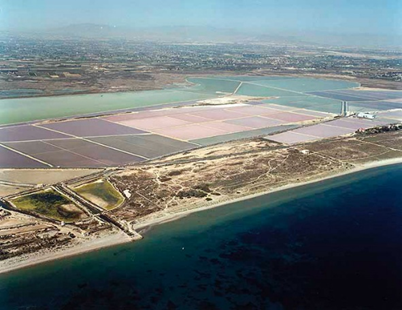
Figure 1: Salt pans at Santa Pola (Alicante, Spain), ecosystems inhabited by bacterioruberin-producing microorganisms.
This is a single pigment that exhibits up to six different biological activities (antioxidant, colouring, anti-lipid, anti-glycaemic, anti-tumour and immunomodulatory), most of which are more potent than the same activities described in other natural compounds, in other words, a single molecule can be used in lower concentrations for different purposes, thereby reducing costs and enabling the design of formulations for new nutraceutical products that provide more and better health benefits.
MAIN ADVANTAGES OF THE TECHNOLOGY
It exhibits biological activities between 100 and 300 times more potent than those described for other natural carotenoids such as β-carotene (C40):
• Antioxidant: ability to slow down or prevent the oxidation of cells and tissues, in both animals and plants.
• Antitumour: selective cytotoxic effect against breast cancer and lymphoma cell lines.
• Antilipid: ability to reduce elevated levels of fats —lipids— in the blood, primarily cholesterol and triglycerides.
• Antiglycaemic: ability to lower elevated blood sugar (glucose) levels in people with diabetes.
• Immunomodulator: stimulates or suppresses the immune system, and may help the body fight cancer, infections or other diseases.
• Colouring agent: High red/orange colouring capacity depending on its concentration (see Figure 2).
INNOVATIVE ASPECTS
The key innovation lies in the fact that a single molecule can be used in lower concentrations for different purposes, thereby reducing costs and enabling the development of formulations for new nutraceutical products that offer greater and better health benefits.
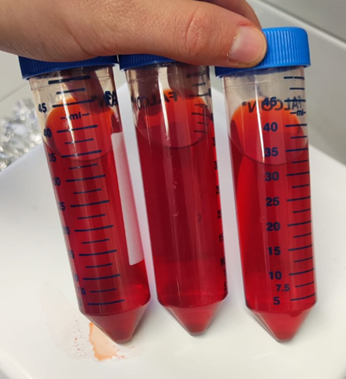
Figure 2: Bacterioruberin extracts (a natural pigment) ready for use in various formulations.
The production process for bacterioruberin is currently at the laboratory stage (up to 100 litres of culture of the producing microorganisms per batch). Furthermore, it has been used to fortify olive oil and sea salt, with positive results. Research is currently ongoing into the stability of the product’s organoleptic properties and biological activities, as well as its effect on tumour cell lines representative of other types of cancer.
It has a wide range of applications in the food, nutraceutical and cosmetics industries, for example:
• As an antioxidant for food preservation.
• As a colouring agent in the production of creams, sweets and candies.
• As a lipid-lowering agent, hypoglycaemic agent and antioxidant in the manufacture of nutraceuticals.
• Specifically in the cosmetics sector, it has great potential as:
o Skin barrier / anti-redness (soothing)
o Anti-ageing (antioxidant)
o Complementary sun protection
We are seeking companies interested in collaborating with the research group on:
• Development of co-formulation and product stability projects based on bacteriorruberin, covering both oil-in-water (O/W) and water-in-oil (W/O) systems. Micro/nano-encapsulation is also a possibility.
• Projects on photostability and the compatibility of UV filters with other components of the formulation (such as preservatives, antioxidants and thickeners).
• Projects on efficacy focused on specific properties:
o Antioxidant (food preservation).
o Antioxidant, anti-lipid, anti-inflammatory and anti-glycaemic (nutraceuticals).
o High pigmentation capacity.
• Safety and regulations: ingredient dossier (toxicology, stability, specifications, IFRA where applicable), labelling/INCI, compatibility with EU markets.
• Product development: oils, sauces, vinaigrettes, fortified salts or nutraceutical formulations.
• Market launch: narrative on natural origin and extremophiles, comparative testing against reference antioxidants.
The technology is protected by the research group’s know-how, accumulated over many years, and has resulted in publications in highly prestigious scientific journals:
• A New Era for Using Natural Pigments: The Case of the C50 Carotenoid Called Bacterioruberin. Giani M, Valdés E, Miralles-Robledillo JM, Martínez G, Pire C, Martínez-Espinosa RM.Biotechnol Appl Biochem. 2025 Oct 22. doi: 10.1002/bab.70072
• Bacterioruberin extract from Haloferax mediterranei induces apoptosis and cell cycle arrest in myeloid leukaemia cell lines. Baeza-Morales A, Pascual-García S, Martínez-Peinado P, Navarro-Sempere A, Segovia Y, Medina-García M, Pujalte-Satorre C, García MM, Martínez-Espinosa RM, Sempere-Ortells JM.Sci Rep. 2025 Jul 2;15(1):23485. doi: 10.1038/s41598-025-06999-3.
Pharmacology, Cosmetics and Ophthalmology


Carretera San Vicente del Raspeig s/n - 03690 San Vicente del Raspeig - Alicante
Tel.: (+34) 965 90 9959