
Can we help you?
Contact us

Can we help you?
Contact us
Thank you for contacting us
Your form has been submitted successfully Our team will contact you again as soon as possible.
Whooppss...!! An error has occurred
Try sending later or write an email directly to areaempresas@ua.es

INFO
SHEET
DOWNLOAD
EXECUTIVE
ABSTRACT
CONTACT DETAILS: Research Results Transfer Office-OTRI
University of Alicante
Tel.: +34 96 590 99 59
Email: areaempresas@ua.es
http://innoua.ua.es
The Lucentia research group at the University of Alicante has developed developed a technology for the identification, sorting and intelligent management of waste packaging in industrial recycling environments, based exclusively on optical techniques and Artificial Intelligence (AI) algorithms. The solution enables the automated, real-time recognition of packaging materials and their components (such as caps), the detection of chemical contaminants regardless of labelling, and the accurate counting of processed items, even in highly variable and densely packed scenarios.
The system can be easily integrated into industrial production lines through communication with programmable logic controllers (PLCs), using standard protocols, and does not require an internet connection. By processing video sequences using optimised neural network models, the technology analyses the optical properties of packaging to classify items and support decision-making, ensuring high accuracy and operational speed.
This innovation helps optimise recycling processes, improve waste traceability, ensure regulatory compliance and reduce operating costs. It is therefore an ideal solution for waste treatment companies.
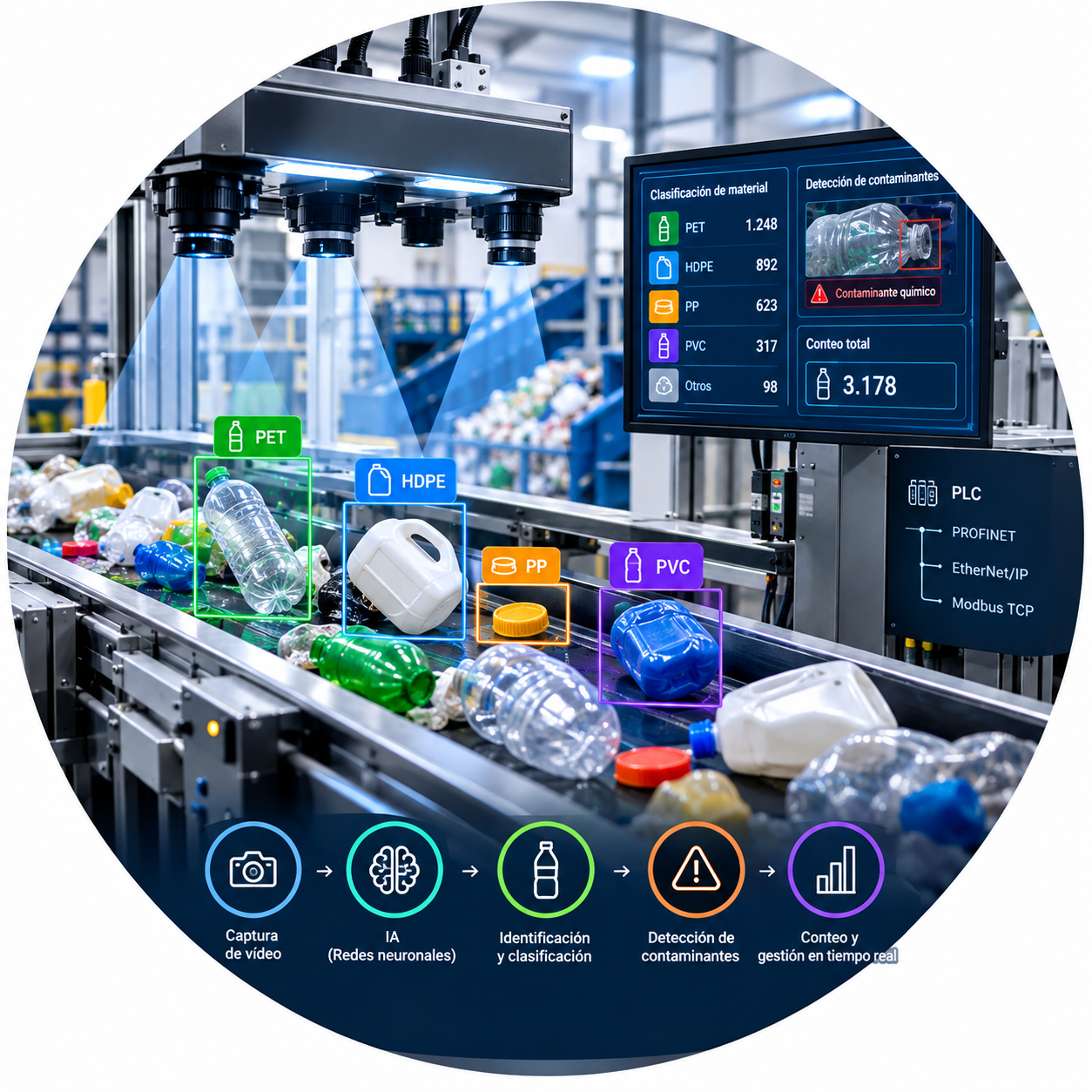
The increasing complexity of waste management and the growing regulatory requirements for recycling make it necessary to develop advanced technological solutions capable of automating packaging identification and sorting. In particular, the presence of heterogeneous materials, additional components such as caps, and potential chemical contamination of packaging pose significant challenges for conventional systems, which often rely on combined optical, chemical or manual techniques that are difficult to integrate and involve high operating costs.
In this context, the technology presented here addresses these challenges through an integrated approach based exclusively on computer vision and Artificial Intelligence. The developed solution enables the identification of packaging materials, the detection of chemical contaminants regardless of labelling, and the accurate counting of processed items, all in real time and fully automatically.
The technology is designed for direct integration into industrial recycling environments, helping to improve process efficiency, reduce costs and ensure compliance with current waste management regulations.
The technology consists of a computer vision and Artificial Intelligence system for identifying, sorting and counting packaging items on recycling lines.
The system uses cameras and controlled lighting conditions to capture images in real time, which are then processed using deep learning models. These models identify packaging materials, detect associated components and recognise the presence of contaminants based on their optical properties.
The device comprises a protective, enclosed housing designed for industrial environments. It incorporates an inlet for introducing packaging items, an internal chamber containing a conveyor belt—which may be inclined—to transport them, and a lower outlet connected to sorting systems. The system includes an adjustable LED light source to ensure controlled illumination, as well as a strategically positioned imaging camera that captures real-time video sequences as packaging items pass through the device.
Data processing is carried out by a programmable module incorporating Artificial Intelligence models based on convolutional neural networks (CNNs), optimised for real-time operation.
The implemented method comprises several sequential stages: real-time image acquisition; preprocessing using affine transformations to geometrically normalise packaging items; detection and recognition using deep learning models; verification of results against external catalogues; analysis of object overlap; and dynamic counting based on adaptive regions of interest (ROIs). Finally, the system generates an output signal that is transmitted to a programmable logic controller (PLC), which controls the physical sorting of packaging items using mechanisms such as air jets or diverters.
Communication with industrial systems is carried out through standard protocols such as Ethernet/IP and OPC UA, facilitating integration into existing infrastructures. The system operates without an internet connection and can process between 20 and 60 frames per second (fps), ensuring real-time performance.
MAIN ADVANTAGES OF THE TECHNOLOGY
The technology offers the following advantages:
• Automated packaging sorting using optical information alone, eliminating the need for chemical, spectroscopic or mechanical techniques that are more costly and complex to integrate.
• Multiple functions in a single system, combining material identification, contaminant detection and accurate item counting, thereby reducing the need for additional equipment.
• High accuracy in complex environments, including situations involving overlapping objects and substantial variation in packaging sizes.
• Real-time operation (20–60 fps), enabling integration into high-speed industrial lines without creating bottlenecks.
• Straightforward integration with industrial systems, including PLCs, through standard communication protocols, facilitating deployment within existing infrastructures.
• Autonomous operation without an internet connection, enhancing system robustness and security in industrial environments.
• Reduced operating costs by replacing multi-method solutions with an architecture based on computer vision and Artificial Intelligence.
• Improved traceability and process control, contributing to more efficient waste management and compliance with applicable regulations.
INNOVATIVE ASPECTS
The main innovative features of the technology are as follows:
• Comprehensive sorting based exclusively on computer vision, avoiding the combination of optical, chemical and physical techniques commonly used in existing systems, which complicates industrial integration.
• Simultaneous identification of packaging materials, associated components (such as caps) and chemical contaminants based on optical properties, without manual inspection or label reading.
• Real-time analysis of complete video sequences, rather than relying on isolated images or indirect analysis, improving robustness in dynamic environments.
• Accurate packaging counting under high-density and overlapping conditions, overcoming the limitations of conventional approaches based on regions of interest (ROIs) or density estimates, which typically provide only approximate counts.
• Built-in industrial decision-making capabilities through direct PLC communication, enabling full automation of the sorting process without intermediate systems.
• Replacement of conventional contaminant detection approaches based on spectroscopy, X-rays or label inspection with a non-invasive, more cost-effective and readily scalable system.
• Integration of multiple tasks within a single architecture—material sorting, contaminant detection and item counting—that are usually handled separately, significantly reducing system complexity and implementation costs.
• An industrialisable, autonomous design capable of operating in real time without an internet connection, increasing robustness in production environments.
The technology has been developed to the functional prototype stage. The system's operational performance and computational efficiency have been evaluated. The technology could be readily implemented in industrial environments.
The technology is primarily applicable to waste management and the circular economy, particularly automated packaging sorting processes at municipal solid waste (MSW) and lightweight packaging recycling plants.
The University of Alicante is seeking companies interested in acquiring the technology for commercial exploitation through licensing agreements, as well as companies interested in developing R&D projects through technical cooperation to further develop and implement related applications.
The technology is protected by two patent applications.
• Patent title: “Dispositivo y método de detección y reconocimiento de la tipología de contaminante en un envase y conteo de envases”.
• Application number: P202531163
• Application date: 09/12/2025
• Patent title: “Dispositivo y método para reconocer envases residuales”.
• Application number: P202531162
• Application date: 09/12/2025
Pollution and Environmental Impact
Computer Science, Language and Communication
Engineering, Robotics and Automation
Materials and Nanotechnology


Carretera San Vicente del Raspeig s/n - 03690 San Vicente del Raspeig - Alicante
Tel.: (+34) 965 90 9959