
Can we help you?
Contact us

Can we help you?
Contact us
Thank you for contacting us
Your form has been submitted successfully Our team will contact you again as soon as possible.
Whooppss...!! An error has occurred
Try sending later or write an email directly to areaempresas@ua.es

INFO
SHEET
DOWNLOAD
EXECUTIVE
ABSTRACT
CONTACT DETAILS: Research Results Transfer Office-OTRI
University of Alicante
Tel.: +34 96 590 99 59
Email: areaempresas@ua.es
http://innoua.ua.es
The Joint Research Unit in Biomedical Design and Manufacturing (BioFab), consisting of researchers from the University of Alicante and the Alicante Institute for Health and Biomedical Research (ISABIAL), has developed a device for connecting a pharmaceutical vial to a dropper bottle, allowing the transfer of substances or components of the medicine, preventing any leakage and ensuring that the solution in the bottle remains sterile. It also facilitates the mixing of materials in different phases, such as freeze-dried powder and liquid. This makes it possible for both pharmacists and users themselves to prepare physiological solutions quickly and easily.
BioFab is looking for companies that manufacture materials for the pharmaceutical or laboratory sector and are interested in developing a prototype of the device, validating and exploiting it (through licensing agreements) or designing other new devices.
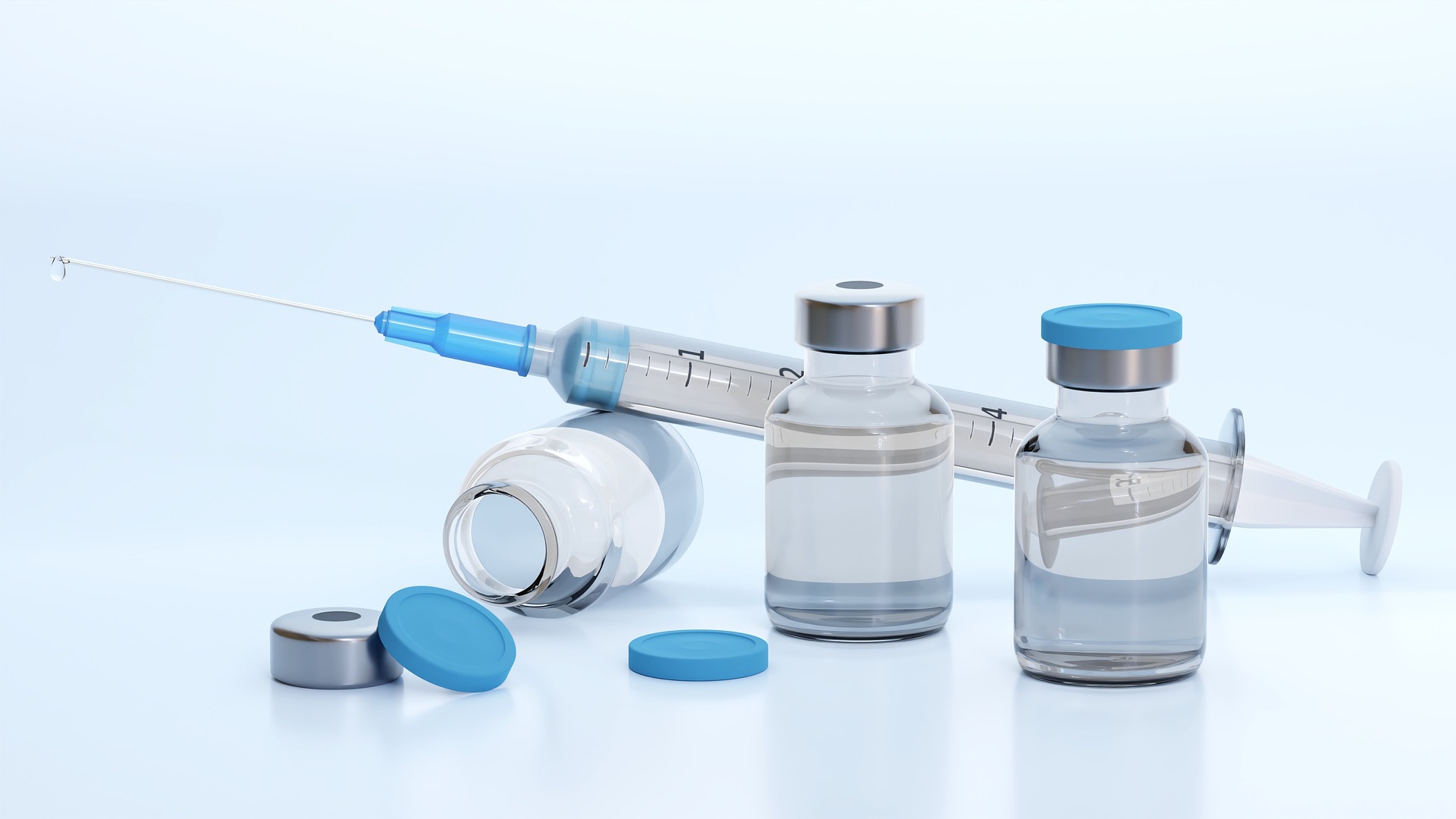
Currently, there are numerous medicines composed of substances that are chemically unstable when found in an aqueous medium. These medicines cannot be manufactured by the pharmaceutical industry in solution form so that they can be administered to patients without prior handling.
This is the case, for example, of eye drops, which, due to their short shelf life, must be prepared immediately before administration to the patient. This handling is usually carried out in hospital pharmacy services, as reconstitution requires dilution and fractionation of the contents of pharmaceutical vials using syringes and needles under aseptic techniques. The same applies to medicines containing soluble powdered or lyophilised (insoluble) substances that need to be mixed.
Therefore, it remains the task of healthcare personnel to mix the medicine by introducing the liquid component using a needle capable of piercing the membrane of the pharmaceutical vial containing the solid substance. Likewise, once the mixture has been made, the personnel themselves must extract it and transfer it with the same syringe to a container for use by the user. This procedure allows the medicine to remain sterile and enables the user to use it directly by delivering the mixture in a standard dropper bottle, with the entire process having to be repeated each time the contents of a container are used up, until the patient's treatment is complete.
This process could be facilitated by the connection device of the present invention, a device that guarantees the integrity and sterility of the process, allowing the safe and efficient preparation of the solution without compromising its quality or safety.
The main objective of the invention is to provide a single-piece connector between a dropper bottle and a pharmaceutical vial that maintains the appropriate properties of the substances or components of the medicine throughout the entire process, until the final dosage by the patient or user assisting the patient, and that also keeps the medicine sterile throughout the entire shelf life of the container in the home environment.
For this purpose, the present invention is adapted to standard pharmaceutical vials (with cap and metal seal) and standard commercial eye drop dropper bottles. In this way, it allows the sealed vial cap to be pierced by pressure, and the solid components of the vial and liquids of the dropper bottle to be mixed aseptically and finally transferred to the eye drop dropper bottle, which is what the user ultimately uses to administer the drops to the eye.
This device will enable the pharmaceutical industry to market medicines that are not stable in solution for ocular administration in the form of eye drops, as they can be reconstituted aseptically by the end user when required without the need for any additional materials.
This device, consisting of a single piece, is composed of the following parts (see Figure 1):
• Needle end: This part of the device contains the rigid needle that pierces the sealing membrane of the pharmaceutical vial, allowing the liquid to be transferred to the vial. The needle has two internal cylindrical holes that allow the liquid to enter and the air to escape, facilitating the mixing of the components without creating a vacuum during the process.
• Outer flap: The outer flap consists of four flaps that allow for a secure fit to the vial. These flaps open slightly, facilitating the attachment of the device to the pharmaceutical vial. This design ensures that the device remains firmly connected, preventing unwanted movement during the transfer and mixing process.
• Internal tabs: The internal tabs work together with the outer flap to provide an additional locking system, preventing the vial and device from moving or disconnecting during the transfer process.
• Threaded end: This end of the device has an internal thread onto which the dropper bottle is assembled. This threaded mechanism ensures a secure connection between the bottle and the device.
• Device body: The main structure of the device, providing its shape, connects both parts (vial and dropper bottle), ensuring that the transfer of liquid is carried out in a controlled and sterile manner.
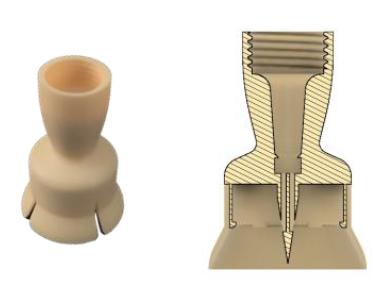
Figure 1: View of the connection device
The device works as follows: the liquid is contained in the dropper bottle and the freeze-dried powder in the pharmaceutical vial. The dropper bottle is attached to the device, and once joined, the vial is pierced. When the vial is pierced, the liquid is introduced from the dropper bottle into the vial by pressing the latter. Once the liquid is inside the vial, the entire assembly (bottle, device and vial) is shaken to mix the two compounds. After the mixture has formed, the assembly is turned, placing the vial on top and the bottle on the bottom. In this position, the dropper bottle is pumped, allowing the mixture to be extracted from inside the vial. When the mixture has been completely transferred to the dropper bottle, the device is unscrewed from the bottle, and the vial and device are discarded, leaving only the dropper bottle with the mixture inside.
MAIN ADVANTAGES OF THE TECHNOLOGY
The numerous advantages of the device are worth highlighting:
• Creation of sterile physiological solutions using a sealed system; the mixture obtained is transferred to a dropper bottle ready for use.
• It allows solutions to be created for patients (domestic use), not just for healthcare personnel (clinical use), thus making them more accessible.
• It reduces the workload of healthcare personnel and the pharmacy service.
• Ease of use and, therefore, time savings, leaving behind the use of needles/syringes to perform this type of transfer.
• It allows for the urgent and immediate availability of eye medications, without the delays of preparation in the pharmacy service.
• The flaps on the device offer a degree of flexibility, making it easier to fit onto the vial. However, the needle needs to be more rigid to prevent it from bending or breaking when piercing the vial membrane.
• In addition, specific kits with clear instructions will be developed to ensure that the process is carried out correctly and safely at home.
INNOVATIVE ASPECTS
Both the design and manufacturing process of the device have been optimised so that it can be produced using a 3D printer which, together with the use of three-dimensional models, has become an alternative manufacturing process to the conventional one (plastic moulding or injection). Its application within the biomedical sector opens up endless possibilities for improving the quality of life of patients and healthcare personnel.
This new form of production, already used in many sectors, is perfect for short runs as it offers great flexibility and the possibility of customisation. In addition to the low cost of materials and equipment required, it also offers rapid manufacturing.
The technology is currently at the laboratory stage, the result of the work carried out and the collaboration of a large number of healthcare specialists who have adjusted the dimensions and characteristics of the device.
It is primarily aimed at the pharmaceutical sector or laboratory equipment manufacturers seeking to improve the work of healthcare personnel and the treatment of patients with certain medicines.
We are seeking companies interested in developing a prototype, validating it and exploiting it (through licensing agreements) or in designing other new devices.
• Patent title: “Dispositivo de conexión para generación de solución estéril en frasco goteador a partir de vial farmacéutico con medicamentos en forma de polvo o liofilizados”
• Application number: P202531213
• Application date: 19/12/2025


Carretera San Vicente del Raspeig s/n - 03690 San Vicente del Raspeig - Alicante
Tel.: (+34) 965 90 9959